

How Much Does Xeriscaping Cost in Denver? (2026 Prices)
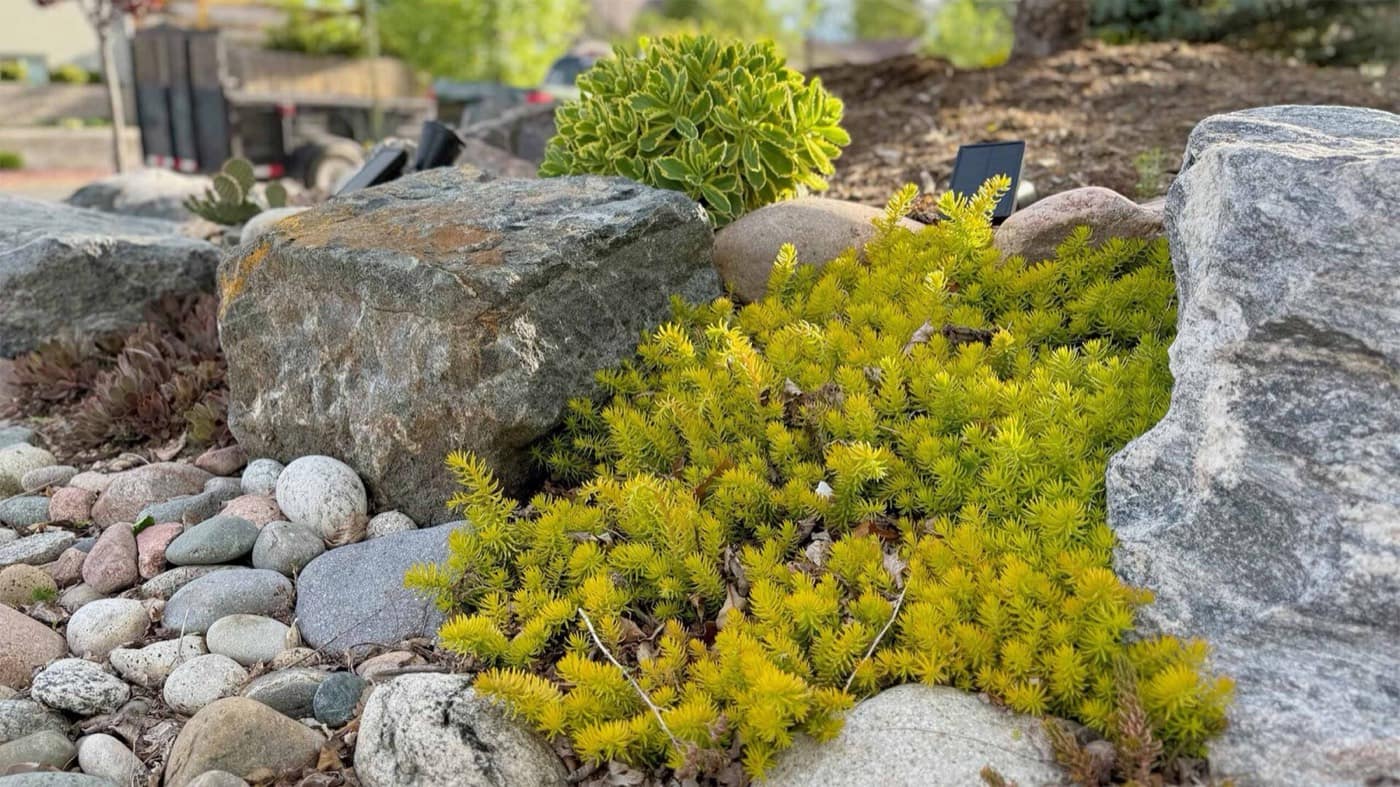
Most full xeriscape installs we build in Denver land between $6 and $10 per square foot. That covers the rock, mulch, plants, shrubs, and a tree or two, installed. Budget-friendly designs start around $4 per square foot, boulder-heavy premium designs run $8–12, and patios and turf are priced separately. A real number comes from walking your yard, but the tables below will get you close.
If you're ready to talk about your own yard, start with our xeriscape installation service. If you're still researching, keep reading.
Xeriscape cost per square foot
These are our published starting prices for 2026.
| What you're installing | Our price | Notes |
|---|---|---|
| Xeriscape / general landscaping | From $6/sq ft, most projects $6–10 | Rock and mulch coverage, native plants and shrubs, maybe a tree or two |
| Budget-friendly options | From $4/sq ft | Wildflower planting or arborist mulch instead of rock (our Bohemian Woodland look runs $4–8) |
| Premium, boulder-heavy designs | $8–12/sq ft | Large quarried boulders and dense planting, like our Outback theme |
| Concrete and hardscape | From $8/sq ft | Patios, paths, and walls |
| Artificial turf | From $10/sq ft | See the artificial turf cost guide |
| Sod removal only | $1.25–1.75/sq ft | Cut, roll, and haul away. $1.75–2.25 with grading and weed barrier. $450 job minimum. See sod removal |
| Design | $500 | Credited toward the project on installs over $5,000 |
You can browse the eight design themes, and what each one costs, in our Design Center.
What a Denver yard costs by size
At $6–10 per square foot for a planted xeriscape:
| Area | Typical range | What that usually is |
|---|---|---|
| 500 sq ft | $3,000–5,000 | A small front yard or side yard |
| 1,000 sq ft | $6,000–10,000 | An average Denver front yard |
| 2,000 sq ft | $12,000–20,000 | A large front yard, or front plus a small back |
| 3,000 sq ft | $18,000–30,000 | Front and back on a typical city lot |
Add a patio or path at $8+ per square foot for that portion. The $500 design fee is credited back on anything over $5,000, so on most full-yard projects design costs nothing extra.
For reference, our recent full-yard projects landed here:
- Front yard in Englewood — about $20–25K
- Front yard in Arvada — about $20–25K
- High-desert front yard in Harvey Park, Denver — about $20–25K
- Front yard and streetscape in Platt Park, Denver — about $40–45K, including concrete work and custom steel fencing
What drives the price up or down
Hardscape. Flagstone patios, concrete, big boulders, and fencing are the most expensive parts of any build. Plants are one of the cheaper parts.
Removing what's there. Taking out a lawn, old rock, or a dead patio adds labor and dump fees. Sod with soil attached weighs about nine pounds per square foot, so a 1,000 sq ft lawn is several tons to haul.
Soil prep. Denver clay needs loosening and, in planting areas, some amendment. Skipping it is the most common reason a new xeriscape struggles in year one.
Irrigation. Converting spray zones to drip costs money up front and pays you back in water. It's also the system you can still run under Denver Water's current rules.
Plant size. Smaller plants cost less and often establish faster than big ones. Mature specimens make sense for a few focal points, not for every slot.
Access and slope. Narrow side gates, stairs, and steep grades mean more carrying by hand, and that means more labor.
When you compare quotes, check what each one includes: removal and haul-off, soil prep, drip conversion, weed barrier where it belongs, and design. Two numbers that look far apart are often covering different scopes.
What it costs to run afterward
This is where a xeriscape earns its keep.
- Denver Water puts a typical lawn at about 12 gallons of water per square foot per year. One of its customers got a xeriscape down to about one gallon per square foot (Resource Central). Another Denver Water customer with an 11,000 sq ft lot saves about 133,000 gallons a year.
- Drip irrigation is roughly 90% efficient, compared with 50–70% for a typical sprinkler system (Resource Central).
- The EPA estimates outdoor watering can be as much as 60% of household water use in dry regions, and up to half of it is lost to wind, evaporation, and runoff (EPA WaterSense).
Then there's the rule change. Denver Water has been in Stage 1 drought since March 2026, and from October 1, 2026, watering grass and running spray irrigation is prohibited. Trees, shrubs, and plants on drip or a hand-held hose are still allowed (Denver Water). Other metro cities have tightened rules too (The Denver Post). A planted, drip-watered yard keeps working under those rules. A lawn doesn't.
Upkeep drops too: no mowing, no fertilizing, no aerating. You still have seasonal work — cutbacks, some weeding, mulch top-ups. Our seasonal maintenance guide lays it out.
Rebates in 2026
- Denver Water: its 2026 residential offer was up to $750 off Resource Central's own turf-removal service, and every 2026 discount has been allocated. Resource Central isn't taking new applications this year (Denver Water). Watch for the 2027 program.
- Aurora Water (GRIP): $3 per square foot for a traditional water-wise landscape and $0.50 for water-wise grass. Aurora Water has to approve the project before installation, and rebates aren't retroactive (Aurora Water).
- Other cities: Thornton, Westminster, Castle Rock, and others run their own programs, and they change every year. Check your water provider before any work starts.
Almost every program requires approval before the grass comes out. We'll tell you which programs apply to your address, and you apply directly. Our Denver rebate guide goes deeper.
How to keep the cost down
- Phase it. Do the front yard this year and the back next year. Put in the hardscape and main beds first and fill in plants later.
- Go native and go small. Native plants in smaller sizes cost less and establish well. See our top native plants for Denver.
- Mix materials. Mulch beds cost less than wall-to-wall rock, and they're cooler and better for plants.
- Keep what works. Healthy trees, a sound patio, and good edging can stay.
- Plant in spring or fall. Plants establish with less water. See the best time to xeriscape.
Is it worth it?
On water savings alone, payback takes years. Anyone promising a two-year payback is guessing. The case for doing it now is everything together: a lower water bill every summer, no mowing, a yard that stays legal to water under drought rules, and one that still looks good in August. If you're staying in the house a few years or more, it usually pencils out. If you're selling next spring, focus on the front yard.
Common questions
What's the cheapest way to xeriscape? Remove the lawn, go heavy on mulch and native plants, and keep hardscape small. Our budget-friendly options start at $4 per square foot.
Is xeriscape cheaper than artificial turf? Usually. Our xeriscape installs start at $6 per square foot and our turf starts at $10. Turf also doesn't cool the yard or feed pollinators. Our honest take on artificial turf covers when it's the right call.
Can I remove the lawn now and landscape later? Yes. Sod removal is priced on its own, and if you book design and install within 30 days, the removal is credited toward it. See lawn removal in Denver for the options.
What about a whole-yard makeover with a patio, lighting, and more? Our Denver yard makeover guide covers bigger, mixed-scope projects.
Get a real number
We design and install xeriscapes across Denver and the surrounding cities. Request an estimate and we'll walk your yard, measure it, and give you a real price.