

How Much Does Artificial Turf Cost in Denver? (2026 Pricing Guide)
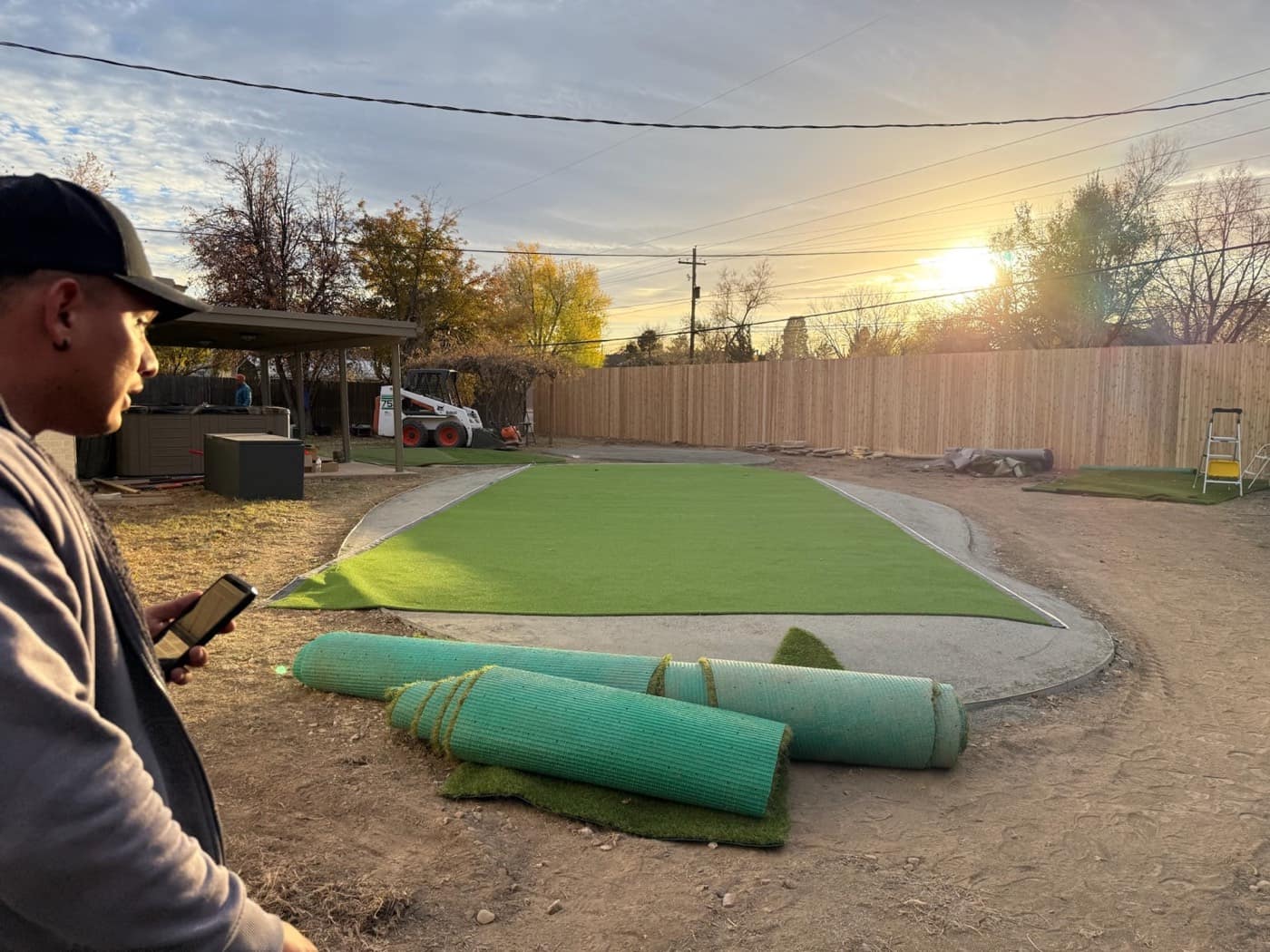
If you've spent more than twenty minutes researching artificial turf costs online, you've noticed something: nobody will give you a real number. Lead-gen sites throw out ranges wide enough to drive a truck through. Contractor websites skip pricing entirely and funnel you straight to a contact form. The few forum posts that share actual invoices are years old and buried under arguments about crumb rubber.
We're going to do the opposite. Our artificial turf installations start at $10 per square foot installed. Below is what moves a project up from there, what common project types pencil out to, and what a solid estimate should include before you sign anything.
Xeris Landscaping installs artificial turf across Denver and the surrounding metro. These are our numbers.

The Real Numbers: What Artificial Turf Costs in Denver
Our price: from $10 per square foot installed. That's the starting rate for a straightforward install. A real number comes from a site visit, because these are the things that move it:
- Base prep depth — Denver clay soil requires 3–4 inches of compacted aggregate base minimum. More excavation and more base material = more cost — but skipping this is the #1 reason turf fails early.
- Infill type — Crumb rubber (recycled tire) is cheapest but increasingly flagged on PFAS and heat concerns. Cork/coconut infill (Corkonut) costs more. Silica sand sits in the middle.
- Pile height and face weight — Higher face weight (ounces of fiber per square yard) means a denser, more realistic look — and a higher material cost.
- Shape complexity — Irregular shapes, curves, and cutouts around trees or beds require more seaming and handwork. Square footage alone doesn't tell the story.
- Access and grade — Tight side yards, significant slopes, or difficult equipment access all add labor time.
- Existing lawn removal — If the grass has to come out first, our sod removal runs $1.25–$1.75 per square foot with haul-away ($450 job minimum). Ask whether removal is in any turf quote you're comparing.
For context, across the Denver market turf installs commonly run $11–$18 per square foot all-in. That's the market range, not our price — it's useful for sanity-checking bids.
If you want to see how every phase of the job actually works — removal, base, seaming, infill — we walk through it in our step-by-step turf installation guide.
Cost by Project Type
Here's what common Denver projects pencil out to at our starting rate. Pet drainage, complex shapes, and removal push the real number up from these floors.
| Project | Typical size | At our $10/sq ft starting rate | What pushes it higher |
|---|---|---|---|
| Pet run or dog area | 300–500 sq ft | from $3,000–$5,000 | Drainage mat, antimicrobial infill, dig-proof edging |
| Family backyard section | 500–1,000 sq ft | from $5,000–$10,000 | Shape complexity, sod removal, cork/coconut infill |
| Full lawn replacement | 1,000–2,000 sq ft | from $10,000–$20,000 | Front and back together, access, removal |
Pet runs: Pet turf requires a dedicated drainage layer and antimicrobial infill. Drainage design matters more here than anywhere else — a poorly draining dog run becomes a health problem fast. More in our artificial grass for dogs guide.
Family backyards: The most common project type. Cost varies most by shape complexity and whether sod removal is included.
Full lawn replacement: Larger projects get some economy of scale on labor, but material costs scale linearly with area.
Putting greens are their own category — putting surface turf is a different product than standard residential turf, with a shorter pile and specific face weight for ball roll, and cups, fringe, and shaping add to the cost. Price those by scope, not by the numbers above.
Turf vs. Xeriscape vs. Bluegrass
If you're weighing turf against a planted, water-wise yard, compare apples to apples. Our xeriscape installs — rock, plants, shrubs, drip — start at $6 per square foot, with most projects landing at $6–10. Our xeriscape cost guide breaks that down by yard size. Turf costs more up front; xeriscape gives you habitat and a yard that looks like Colorado. Plenty of yards end up with both.
Against bluegrass, the comparison is about ongoing cost, not install cost. Resource Central estimates a typical Denver-area lawn uses about 12 gallons of water per irrigated square foot per year — roughly 9,000 gallons a year for a 750 sq ft lawn — plus mowing, fertilizer, aeration, and overseeding. Turf needs a hose rinse, occasional brushing, and an infill top-off now and then. And under Denver Water's 2026 Stage 1 drought rules, watering grass is prohibited starting October 1, 2026, which changes the math for a lot of homeowners this fall.
Run your own numbers — your water bill and what you pay for lawn care are the inputs that matter.

What's Included in a Xeris Estimate — and What Cut-Rate Installers Skip
The spread between a low bid and a high bid for what appears to be the same project usually comes down to three things: base preparation, drainage, and infill quality. Here's what we put in writing on every estimate — and why it matters.
- Full excavation and sub-base — Denver's clay soil doesn't drain on its own. We excavate 3–4 inches and install a compacted aggregate base that gives the turf a stable, draining foundation. Installers who skip this create a drainage problem that shows up in year two or three.
- Weed barrier — A weed barrier membrane goes in as part of the base system — not as a substitute for it. This keeps organic material from migrating up through the system over time.
- Drainage layer specification — For pet areas especially, we specify a dedicated drainage layer above the base. Cut-rate installs often use whatever aggregate is cheapest, regardless of drainage performance.
- Infill — We use cork/coconut (Corkonut) or silica sand — not crumb rubber for residential projects. Cork/coconut costs more per bag and is marketed as the cooler-running option, and neither carries the chemical questions crumb rubber does.
- Proper seaming and edging — Turf seams that are done poorly lift within a few years. We specify seam placement, adhesive, and bender board edging that keeps the perimeter locked down.
- PFAS documentation — We ask the manufacturer for PFAS test documentation on the product we're quoting, and we'll share what they provide. Ask any installer you're evaluating to show documentation, not just say the words.
Questions to Ask Before You Sign a Contract
These are the questions that separate a good installation from a problem you're dealing with in three years — whoever you hire.
- What's the base specification? — Get the exact depth of excavation and aggregate base in writing. Anything less than 3 inches is a red flag in Denver's clay soil. If they can't tell you the spec, they probably don't have one.
- What turf product are you installing, and what PFAS testing backs it? — Ask for the manufacturer name and product line. Then ask for third-party PFAS test documentation — not a verbal assurance. If they can't produce it, that tells you something.
- What infill are you using, and how much? — The type and quantity of infill affects heat performance, drainage, and longevity. Know what's going under the turf before the contract is signed.
- What does the warranty cover — and who backs it? — Product warranty and installation warranty are separate things. Understand what triggers a warranty claim and who you're calling — the installer, the manufacturer, or a third party who may or may not still be in business.
- Is sod/existing lawn removal included in the quote? — This is often a line item that gets added after the fact. Confirm what's included in writing before comparing bids — a lower per-square-foot quote that doesn't include removal isn't cheaper than a higher one that does.
- Can I see a completed project from this year? — Photos are a start. An address you can drive by or a reference you can call is better.
Get a Real Estimate on Artificial Turf in Denver
Xeris Landscaping installs artificial turf across Denver, Lakewood, Arvada, Westminster, Aurora, Englewood, and the surrounding Front Range. We'll walk the site, give you a detailed scope with base specs and product specs in writing, and tell you straight if a different approach makes more sense for your yard. No vague ranges, no bait pricing. Request an estimate.