

Artificial Turf Installation in Denver
Pet-friendly, PFAS-free synthetic grass and putting greens — installed over a base that actually drains, on yards where real grass was never going to work.
- PFAS-free turf only — we don't install products we wouldn't put in our own yards
- Pet systems with proper drainage and antimicrobial infill, so dog runs don't smell
- Engineered base — class II road base, compacted in lifts, so it doesn't ripple or sink
- Custom putting greens with true roll and cup placement
- No watering, no mowing, and it stays green through a Stage 2 drought
Get a free estimate
Tell us what you’re working with. We’ll walk the property and give you a real number.
What’s included
Site walk and honest assessment — including when we think turf is the wrong call for your yard.
Full excavation of existing sod and 3–4 inches of soil, hauled off the property.
Compacted class II base in lifts, laser-checked for grade and positive drainage.
Weed barrier, turf laid with seams glued and nailed, and edges secured to a real border.
Infill matched to use — antimicrobial for pets, silica for putting greens, cooling infill on full-sun installs.
Cleanup, a walkthrough, and straight talk on maintenance so you know what you actually own.
Our artificial turf installs start at $10 per square foot installed; turf grade, base depth, access, and infill move it up from there. That minimum includes a real base — the cheap end of the market usually skimps on base prep, which is exactly what fails in year three.
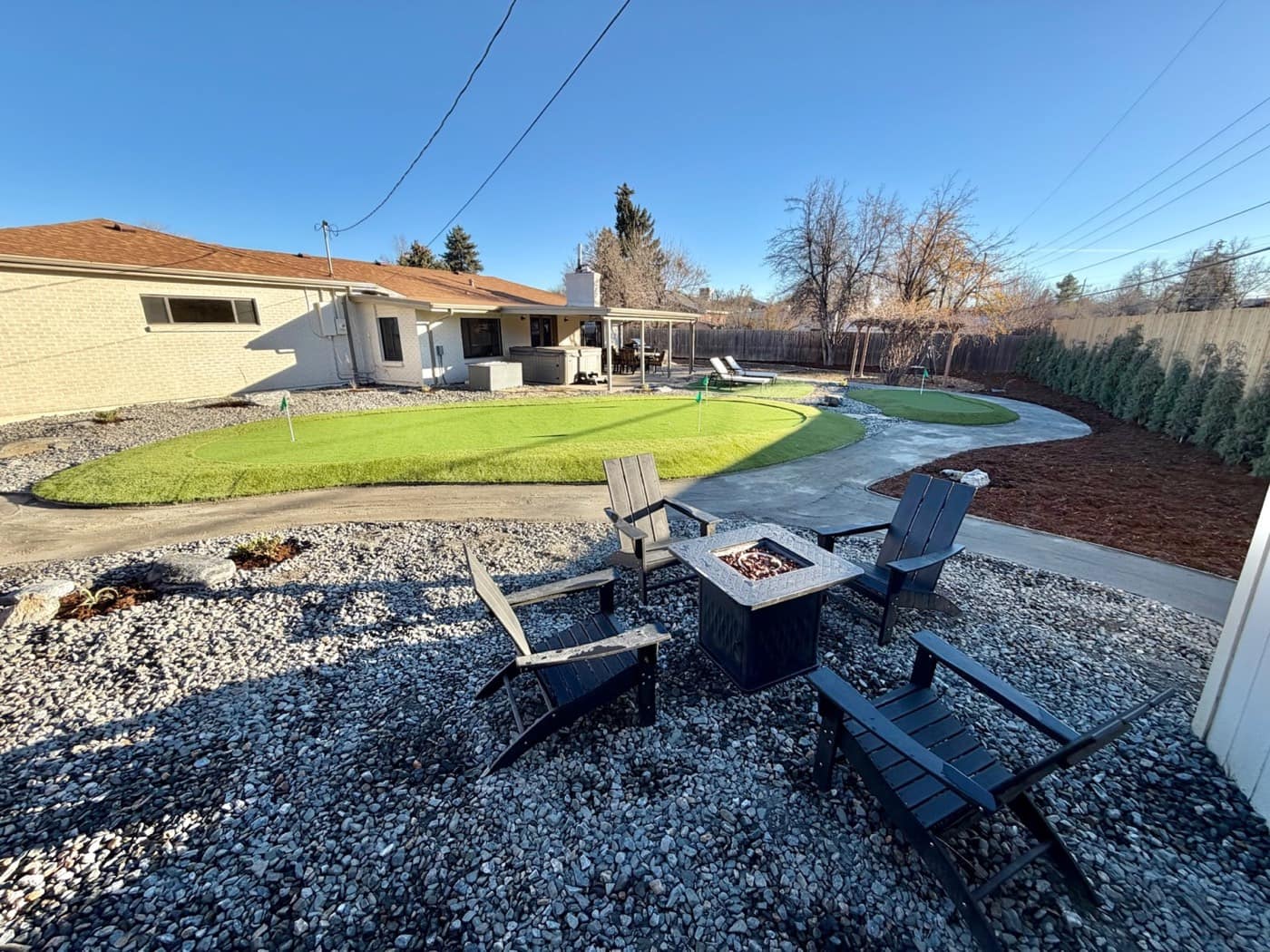
When artificial turf is the right call — and when it isn't
We install a lot of synthetic turf, and we talk a fair number of people out of it. Both of those are the job.
Turf earns its place where living grass keeps failing for a structural reason: a dog run that gets destroyed faster than sod can recover, a deeply shaded side yard where nothing will grow, a narrow strip between a driveway and a fence that's impossible to irrigate efficiently, a kids' play area that sees traffic every single day, or a putting green where you need a consistent surface.
Turf is the wrong call as a wall-to-wall replacement for a front lawn you simply don't want to water. That install gets hot, it usually disqualifies you from turf-replacement rebates, it does nothing for pollinators or soil, and it reads as plastic from the street. A planted xeriscape costs less, performs better in heat, and looks better in year three.
The best projects we do use both: synthetic turf in the defined zone where a hard-wearing surface actually matters, planted xeric landscape everywhere else.
The base is the whole job
Turf product is the part people shop. The base is the part that determines whether the install still looks right in five years.
A correct Denver installation means excavating the existing sod plus 3 to 4 inches of soil and hauling it off — not tilling it under. Then class II road base goes in and gets compacted in lifts, not dumped and rolled once, because a deep uncompacted layer will consolidate unevenly under foot traffic and give you dips. The surface gets laser-checked for grade with positive drainage away from the house.
Only then does turf go down: weed barrier, turf rolled and allowed to relax so it doesn't shrink at the seams, seams glued and nailed, edges secured to a real border rather than just spiked into dirt, then infill brushed in.
Skip or thin any of those steps and the failure mode is predictable: ripples across the seams, low spots that hold water, edges lifting at the driveway, and infill migrating downhill. That's what most sub-$10-per-square-foot quotes are buying you.
Where turf isn't allowed anymore
Colorado's SB24-005 bars local governments from allowing new artificial or nonfunctional turf on commercial, institutional, and industrial property, HOA common areas, and street medians and rights-of-way from 2026 (athletic fields are exempt). Private residential yards aren't covered by that ban. If you manage an HOA or commercial property, see commercial & HOA landscaping instead.
PFAS, heat, and the things installers don't volunteer
Two honest caveats, because you'll hear them from us before you hear them from your neighbor.
PFAS. Per- and polyfluoroalkyl substances have shown up in synthetic turf products, and testing standards across the industry are inconsistent. We install PFAS-free products and we'll tell you the manufacturer and the documentation. Ask every contractor you talk to for the same, in writing.
Heat. Synthetic turf in full sun at 5,280 feet gets meaningfully hotter than living plants or bare soil. Cooling infill reduces it, shade reduces it more, and lighter turf colors help at the margin — but none of it makes synthetic turf feel like grass on an August afternoon. If the area is a dog run in full southern exposure, that's a real design consideration, not a footnote.
Pet systems and putting greens
Pet installs get a permeable backing, a more open base profile for flow-through, and antimicrobial infill so urine drains rather than pooling. Dog areas need rinsing periodically no matter what anybody promises you; what good construction buys is that rinsing actually works instead of pushing odor into a saturated base.
Putting greens are a different product entirely — shorter pile, heavier silica infill, rolled and compacted for true speed, with contours and cup placement built into the base. If you want a green that putts consistently rather than one that just looks like a green, the money goes into the base shaping. More on putting greens.
Common questions
- How much does artificial turf cost in Denver?
- Our installs start at $10 per square foot, and turf grade, access, and infill move it up from there. Turf product itself is a minority of the cost — the majority is excavation, haul-off, and the compacted base. Quotes well under that almost always mean a thin base or a lower-grade turf, and both show up as ripples, low spots, and drainage problems within a few years.
- Is artificial turf safe for pets and kids?
- The turf we install is PFAS-free, which is not universal in this industry and worth asking every contractor about directly. For pets we use a permeable backing with antimicrobial infill so urine drains through rather than pooling in the base. The honest caveat is heat: synthetic turf in full Denver sun gets significantly hotter than living plants, and that matters for dogs. We plan shade and cooling infill into pet installs rather than pretending it isn't a factor.
- Does artificial turf get too hot in Colorado?
- In full afternoon sun at 5,280 feet, yes — surface temperatures run well above ambient. Cooling infills help, shade helps more, and lighter-colored turf helps some. This is the main reason we push back on wall-to-wall turf installs and recommend it in defined zones instead: a dog run, a play area, a putting green, with planted xeriscape around it.
- Do I still need to remove my existing lawn first?
- Yes. Turf laid over living grass fails — the sod decomposes, the surface settles unevenly, and you get low spots you can't fix without pulling it up. We excavate the sod and 3–4 inches of soil, then build the base. See [lawn removal](/services/lawn-removal/) for what that step involves.
- Does artificial turf qualify for a water rebate?
- Usually not. Most Denver-area turf-replacement rebates require the new landscape to be living, water-wise plants and specifically exclude synthetic turf, or cap how much of the converted area can be non-living. If the rebate is a meaningful part of your budget, plan a planted xeriscape for most of the area and keep the synthetic turf to the zone where you genuinely need a hard-wearing surface.
- How long does it last, and what maintenance does it need?
- A properly based install with a good product should give 15–20 years. It isn't zero maintenance: it needs periodic brushing to keep the blades upright, debris blown or raked off, infill topped up every few years, and rinsing in pet areas. What it doesn't need is water, mowing, or fertilizer.
Read more
Artificial turf in Denver: the complete guide
Is artificial turf worth it in Denver? The honest pros and cons — heat, cost, water, PFAS, and who it makes sense for — from a crew that installs it.
What artificial turf actually costs in Denver
Real 2026 pricing for artificial turf installation in Denver — per square foot costs, project type breakdowns, and what actually drives price variation.
PFAS-free turf: why it matters
Colorado bars installing turf with intentionally added PFAS. Here's what PFAS-free actually means, which tests to ask for, and what to ask your installer.
Artificial grass for dogs
The honest guide to pet turf in Denver — drainage, PFAS-free infill, heat, and what separates an install that lasts from one that smells in year two.
Putting green installation
What a custom backyard putting green in Denver costs and how it's built — hole count, shaping, ball roll, fringe turf, and what makes a green actually roll.
Combining xeriscape and artificial turf
Xeriscape and artificial turf aren't opposites. Here's how Denver homeowners combine both — turf where the yard gets used, native plants everywhere else.
Where we work
We’re Denver-based and work across the metro. Water rules and rebates depend on your provider — each city page covers yours.
Ready to get a number?
We design and build water-wise landscapes across the Denver metro. Free walkthrough, honest scope, no pressure.