

Rock & Decomposed Granite Landscaping in Denver
Decomposed granite paths, rock groundcover, dry creek beds, and boulders — set on a real base, edged so it stays put, and planted so it doesn't read as a parking lot.
- Decomposed granite compacted in lifts with stabilizer where it takes traffic — so paths don't wash out or track into the house
- Steel or stone edging on every rock and DG bed, so material doesn't migrate into the lawn or the street
- Boulders buried to roughly a third of their height, so they read as outcrop, not delivery
- Dry creek beds sized and graded to actually carry storm water
- Rock as a material, not a plan — we plant between it
Get a free estimate
Tell us what you’re working with. We’ll walk the property and give you a real number.
What’s included
Site walk: grade, drainage, traffic, and where material will migrate if it isn't contained.
Excavation and base prep matched to use — a DG path gets a different section than a rock mulch bed.
Weed barrier where it helps (under rock mulch) and not where it hurts (under DG paths and planting pockets).
Edging installed first — steel, stone, or a set cobble border.
Material placed to depth, compacted or raked to finish, boulders set and backfilled.
Planting pockets and drip lines designed in, not cut in afterward.
Rock groundcover, boulders, and plantings fall under our general landscaping rate: from $6 per square foot, typically $6–$10. Compacted DG paths and patios are hardscape, from $8 per square foot. Material choice, boulder size, and access move the number — we price it after walking the site.
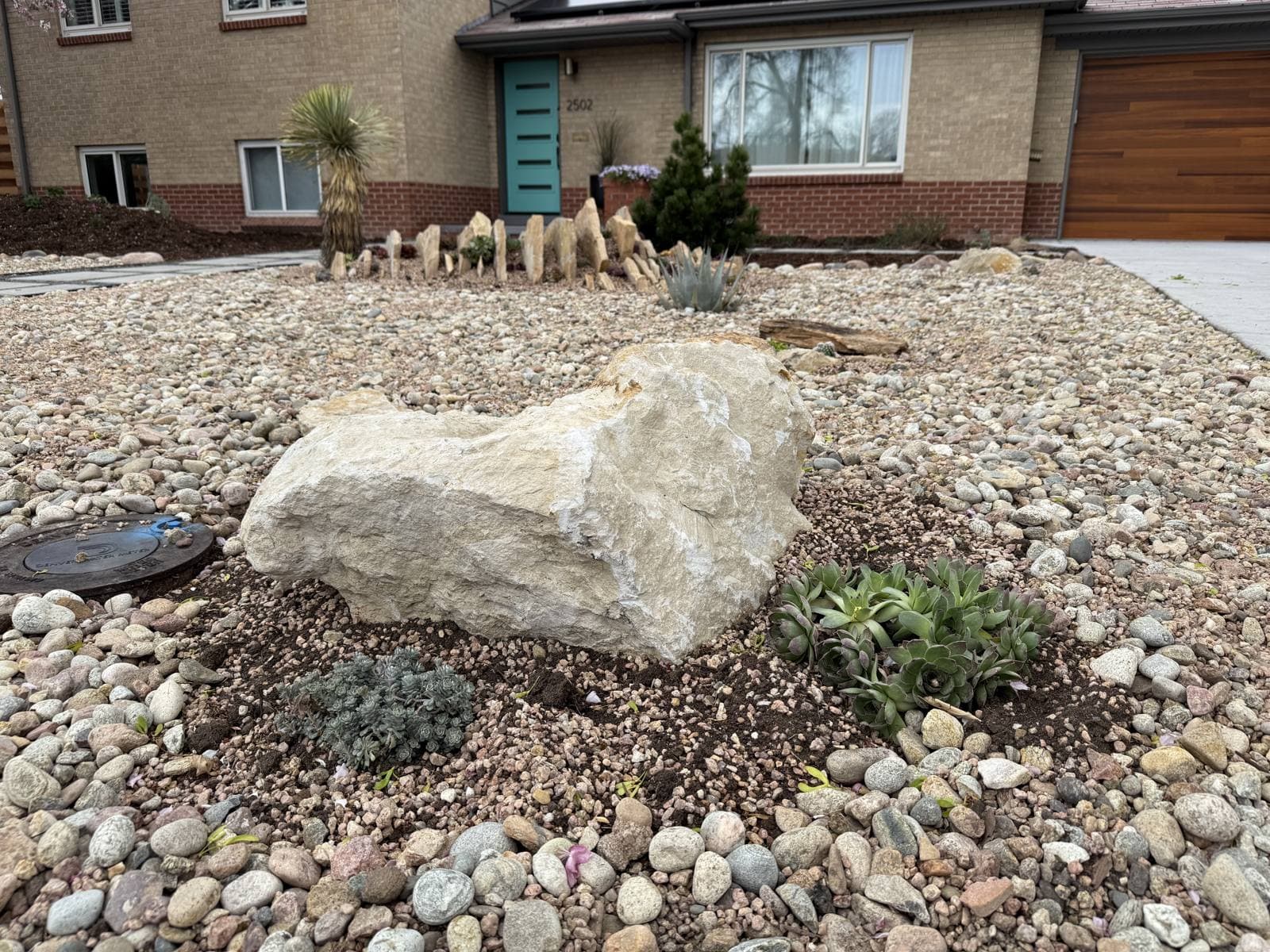
Rock is a material, not a plan
The fastest way to ruin a lawn conversion is to replace grass with a sea of gravel. It gets hot, it reflects heat into the house, weeds still come up through it, and it looks like a parking lot from the street.
Rock and decomposed granite are excellent at specific jobs: firm paths that drain, groundcover that keeps moisture in the soil between plants, boulders that give a planting structure, and dry creek beds that move storm water. We use them for those jobs and plant everything else.
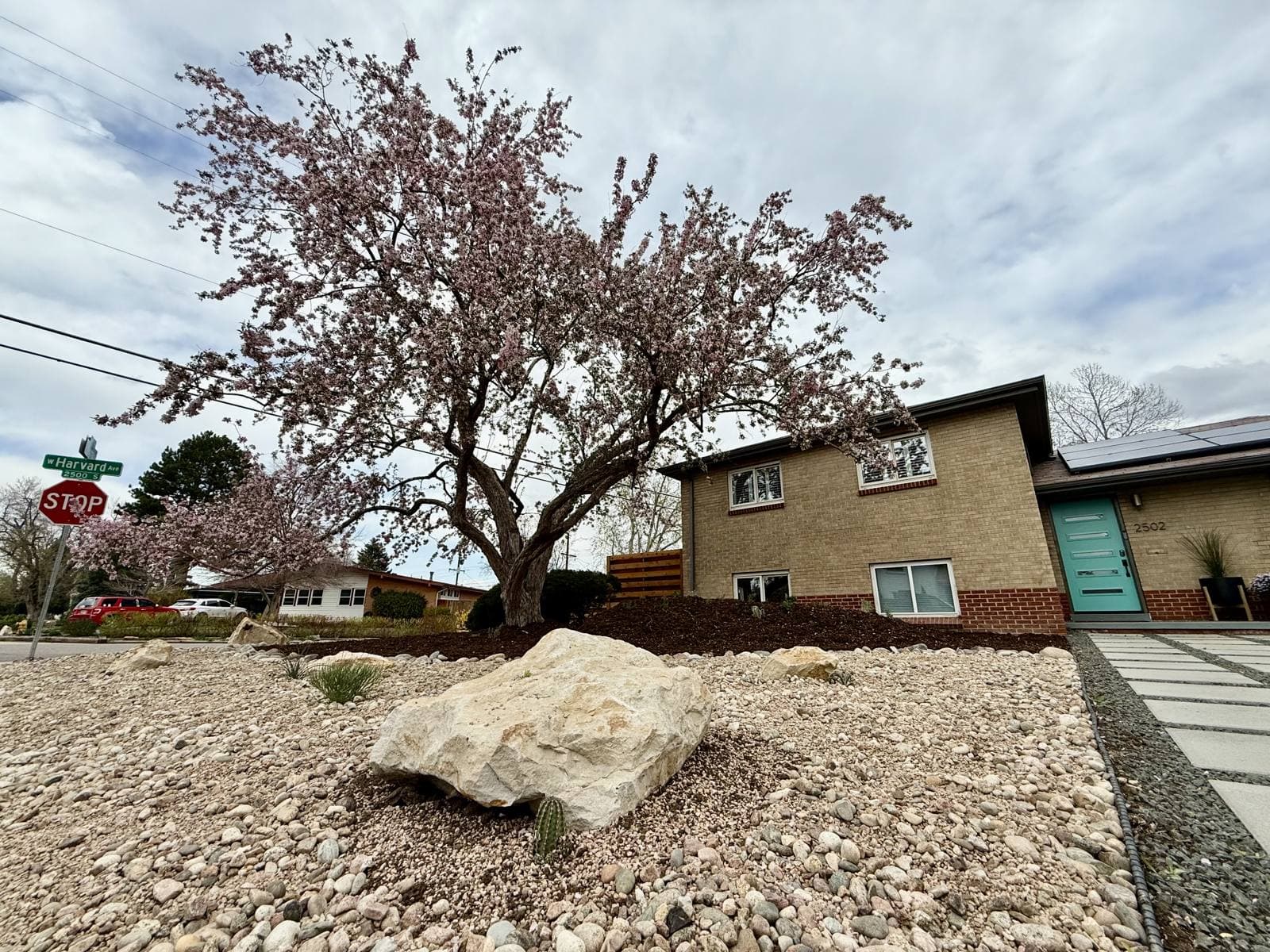
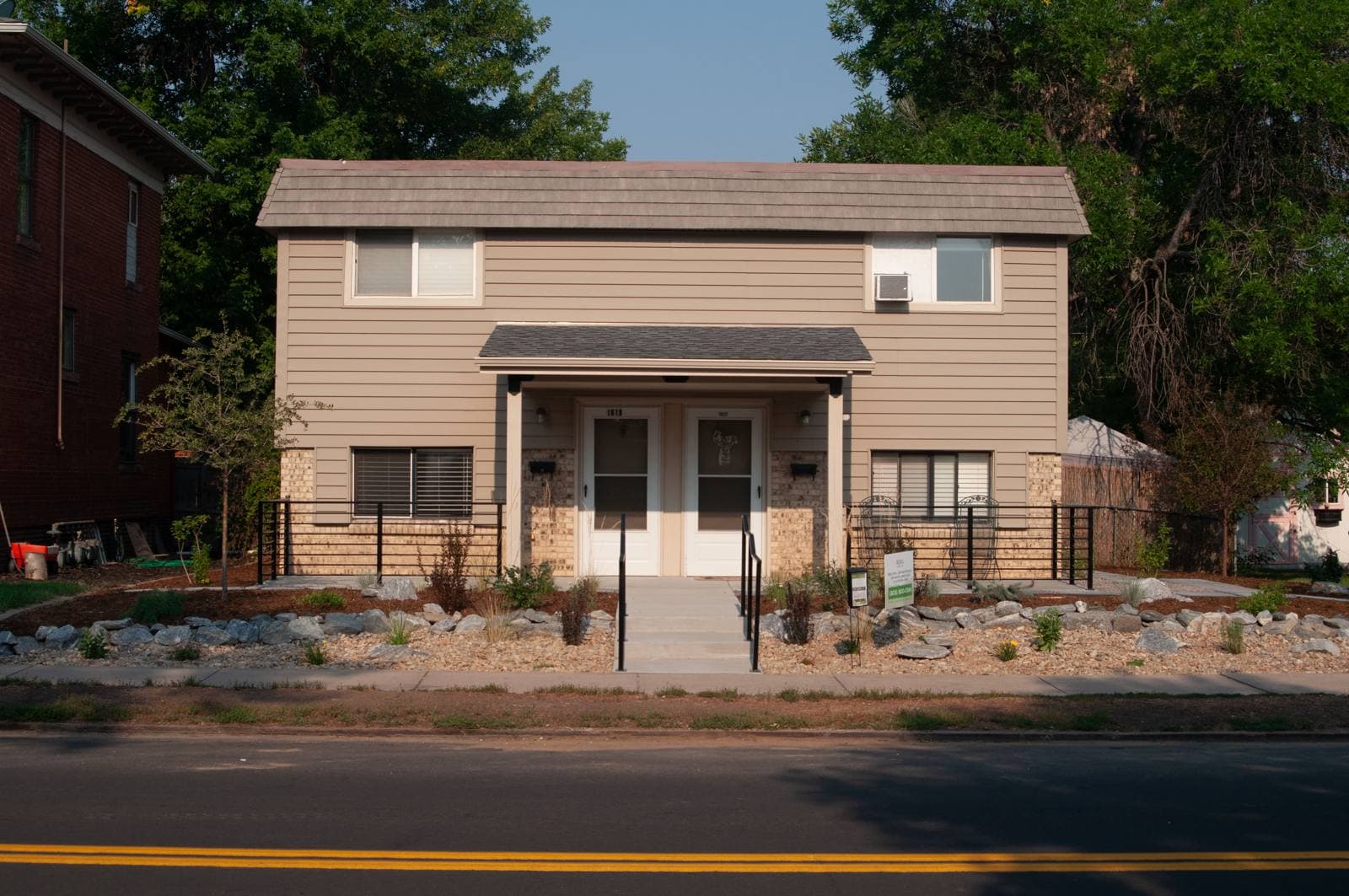
The South Winona yard is a good example — rock groundcover and quarried sandstone boulders carry the structure, and agave, yucca, and succulents tucked into the rock crevices do the rest. At South Pearl, a dry creek bed of quarried boulders and river rock runs the length of the yard, planted with drifts of ornamental grasses.
Decomposed granite, done right
DG fails in three predictable ways: it washes out in a summer storm, it tracks into the house, and it migrates into the lawn next door. All three are construction problems.
Base. A DG path gets excavated, a compacted base goes down, and the DG goes on top in lifts — wetted and compacted each time. Dumped and raked, it stays loose forever.
Stabilizer. On main paths and seating areas, a stabilizing binder locks the particles together once it's wet and compacted. That's what keeps it from washing and tracking.
Edging. Steel, stone, or a set cobble edge contains it. Without edging, DG spreads a little every storm until the crisp line is gone.
Slope. DG doesn't belong on steep grades. On a slope we switch to steps, flagstone, or larger crushed rock — see hardscaping.
Choosing rock
We work with Front Range stone that looks like it belongs here: tan decomposed granite, Breckenridge gold, chip mountain granite, river rock and cobble, pea gravel, and sandstone and granite boulders. Warmer tans and golds sit well against brick and stucco; grays and granites suit modern homes. We bring samples to the walkthrough so you can see them against your house, not on a screen.
Size matters as much as color. Small crushed rock (under an inch) walks well and suits paths and tight beds. Larger rock (two to four inches) stays put on slopes and in drainage channels. Cobble and river rock are for creek beds and edges, not for walking on.
Boulders
Boulders are placed, not dropped. We bury them to roughly a third of their height and orient them the way stone sits in the foothills — grouped, grain aligned, never evenly spaced. Set right, a boulder looks like the house was built around it. Set wrong, it looks like it fell off a truck.
Plant between it
Every rock bed we build has planting pockets designed in, with drip run to each one before the rock goes down. Low natives, grasses, and succulents soften the stone, shade it, and keep the yard from reading as bare. See plant & install for how we pick them.
Common questions
- What is decomposed granite, and is it good for Denver yards?
- Decomposed granite is granite weathered down to fine gravel and grit. Compacted, it makes a firm, permeable surface for paths and informal seating areas; loose, it works as a mulch between plants. It suits Denver well because it drains, it doesn't need water, and the colors match the Front Range. It's a poor choice on steep slopes and anywhere you need to roll furniture or a wheelchair.
- Stabilized or regular DG?
- Stabilized DG has a binder mixed in that locks the particles together once it's wetted and compacted. It's the right choice for main paths and seating areas because it resists washout and tracking. Regular DG is fine for low-traffic areas and as a mulch between plants. On anything that gets real foot traffic, stabilizer and a compacted base are what keep the path looking like a path.
- Does rock make a yard hotter?
- Large expanses of bare rock and gravel absorb and re-radiate heat, and at 5,280 feet in full sun that's real. The fix is design: use rock where it does a job — paths, drainage, mulch between plants — and plant the rest, with shade where people spend time. Wall-to-wall gravel is the version to avoid.
- Do I need weed barrier under rock?
- Under rock mulch beds, a quality woven barrier helps. Under DG paths it usually doesn't — the compacted base does the job and fabric can create a slip plane. Around plants, barrier gets cut back so roots and water reach the soil. No barrier stops weeds forever; windblown seed lands on top. Expect some light weeding either way.
- Will rock count toward a turf-replacement rebate?
- Usually only partly. Most programs require a minimum share of the converted area to be living plants and cap how much can be rock, gravel, or hardscape. If a rebate is part of the budget, the rock-to-plant ratio needs to be designed to the program's rules from the start.
- What's a dry creek bed actually for?
- When it's built right, it carries storm water — from a downspout or a low spot — across the yard and away from the foundation, and it looks like a natural drainage in between storms. That means sizing it to the water it handles, lining it, and setting larger stone on the edges so it doesn't scour. A decorative one that ignores grade is just a line of rocks.
Our work
Read more
Decomposed granite landscaping in Denver: the complete guide
Decomposed granite in Denver — stabilized vs. unstabilized, cost per ton, how to install it right, and how to keep it weed-free long-term.
Rock landscaping in Denver: cost, types, and design
Rock landscaping in Denver — types, costs, design principles that separate great from mediocre, and what maintenance actually looks like.
Hellstrip landscaping
Denver hellstrips bake in summer, get salted in winter, and get walked on year-round. Most plants fail. Here's how Xeris designs them to actually survive.
Xeriscape front yard ideas
12 xeriscape front yard ideas for Denver — from prairie meadow to modern minimal, each designed for Colorado's climate and water reality.
Where we work
We’re Denver-based and work across the metro. Water rules and rebates depend on your provider — each city page covers yours.
Ready to get a number?
We design and build water-wise landscapes across the Denver metro. Free walkthrough, honest scope, no pressure.