

Native & Xeric Plant Installation in Denver
Zone 6a natives, xeric perennials, grasses, shrubs, and trees — sourced from Colorado growers and planted so they actually establish.
- Colorado-grown stock — a blue grama from a Texas seed source won't behave like one from local genotype
- Soil prepped for what's going in: lean and sharp for natives, not blanket-amended
- Drip irrigation installed for establishment — legal to run any day under current restrictions
- Right-sized at planting, spaced for mature size, so year three looks intentional
- Trees planted at correct depth with proper mulch rings, the two things that kill most new trees
Get a free estimate
Tell us what you’re working with. We’ll walk the property and give you a real number.
What’s included
Plant sourcing from Front Range native nurseries, ordered ahead so you get species and sizes that matter.
Bed prep matched to the palette — decompaction, drainage correction, lean amendment where appropriate.
Layout staged on site before anything goes in the ground, so you can see it and adjust.
Planting at correct depth with backfill, watering-in, and settling.
Drip irrigation run to each plant with emitters sized to need.
Mulch, and a written establishment watering schedule you can actually follow.
Our landscaping work starts at $6 per square foot and typically runs $6–$10; wildflower-seeded and arborist-mulch options start at $4, and premium themes run $8–$12. Larger caliper trees and mature shrub stock move a planting up fast. Fall planting usually costs the same and establishes better.
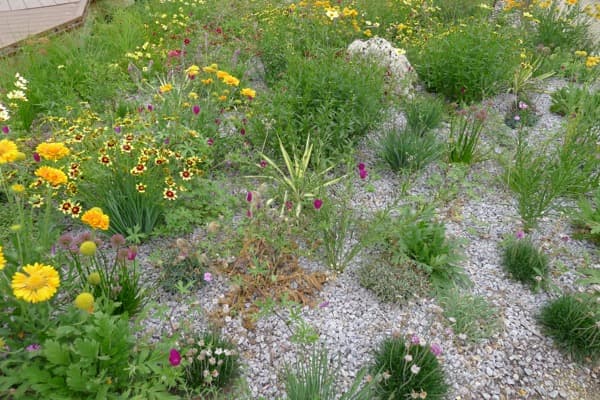
Planting is not the hard part — establishment is
Anyone can put a plant in a hole. What determines whether a xeric landscape looks good in year three is what happens in the first two seasons, and most of that is decided at install.
Planting depth kills more new trees in Denver than drought does. A tree set even a few inches too deep, or mulched up against the trunk, will decline slowly for years and nobody connects it back to the day it went in. Root flare goes at grade. Mulch goes in a ring, not a volcano.
Soil prep has to match the palette. The instinct to amend everything with rich compost is wrong for most natives — they evolved in lean, sharp-draining ground and rot in a bed built like a vegetable garden. We amend selectively and decompact broadly, which is nearly the opposite of the default.
Spacing is a year-three decision made in year one. Spaced for mature size, a new bed looks open. Packed to look finished immediately, it looks great for two seasons and then becomes a thinning project. We stage the layout on site before planting so you can see the spacing and we can talk about it.
Drip is how the plants survive establishment legally. Under current Denver Water restrictions, drip irrigation and hand-watering for trees, shrubs, and perennials are permitted any day of the week, while spray irrigation on lawns is not. A new planting on drip can be watered through establishment; one depending on spray heads cannot.
Sourcing: why we order in winter
You will not find little bluestem, mountain mahogany, or usable sizes of most Front Range natives at a chain garden center. The nurseries that grow them properly are a short list, they grow to order, and they sell out of the popular species by early May.
We order in late winter for spring and summer installs. If you're planning a project and the plant list matters to you, that timeline is the reason to start the design months before you want to plant.
What we plant
Perennials and wildflowers, native and ornamental grasses, xeric shrubs, and shade trees suited to USDA zone 6a (with some 6b pockets) and the Front Range. The specific palette comes out of your site — sun, soil, slope, and how the space gets used — rather than a standard list.
Browse the plants we use for species profiles. For the reasoning behind particular choices, our native alternatives swap list walks through the plants we most often specify and what they replace.
Common questions
- When should I plant natives in Denver?
- Fall is best — soil is still warm, air is cooling, and roots establish through fall and early spring before the plant has to support summer top growth. Spring is second. Midsummer planting works but demands far more establishment water, which is a problem under current restrictions.
- Do native plants really need no water?
- Established natives need very little supplemental water. Newly planted ones need regular water for the first one to two seasons to get roots down — that's not a contradiction, it's establishment. This is exactly why drip matters: hand-watering and drip for trees, shrubs, and perennials remain legal any day of the week under Denver Water's restrictions, while spray irrigation on turf does not.
- Why does it matter where the plants come from?
- Genotype. A blue grama grown from a Texas seed source is the same species as one grown from Colorado stock and will not behave the same way here — timing, cold hardiness, and drought response all differ. We buy from Colorado native nurseries growing Front Range genotypes, and we order in late winter because the good ones sell out of popular species by early May.
- How big are the plants you install?
- Mostly one-gallon and five-gallon for perennials and shrubs, larger for key structural plants and trees. Bigger isn't automatically better with xeric plants — smaller stock frequently establishes faster and catches up within two seasons, because it hasn't been root-bound in a pot.
- Will it look sparse at first?
- Yes, if it's spaced correctly. Plants get spaced for mature size, which means a new planting looks intentionally open in year one. The alternative — packing it to look full immediately — gives you an overcrowded bed you have to thin in year three. We'll show you the mature spacing on the plan so the first season isn't a surprise.
Read more
Top native plants for the Front Range
The 10 native plants we lean on for Denver xeriscapes, plus the shrubs, grasses, and groundcovers that back them up, matched to sun, clay, and season.
Native alternatives: the Denver swap list
Burning bush, boxwood, maiden grass, Kentucky bluegrass — the nursery standards most Denver yards are built on. Here's the Front Range native that does the same job on a fraction of the water.
Best trees for Front Range yards
The best trees for Denver and Front Range yards — 14 tough, proven picks for clay soil, alkaline ground, drought, and brutal cold, by shade, native, and ornamental use.
Plants for a full-xeric Denver yard
Ready to go full xeric in Denver? Here are 22 low-water plants that actually thrive in Front Range clay, altitude, and cold — organized by how you'd use them.
Colorful xeriscape plants
Xeriscape doesn't mean brown and boring. Denver yards can have color from March through October with the right native plants.
Where we work
We’re Denver-based and work across the metro. Water rules and rebates depend on your provider — each city page covers yours.
Ready to get a number?
We design and build water-wise landscapes across the Denver metro. Free walkthrough, honest scope, no pressure.