

Rock Landscaping in Denver: Cost, Types, and Design That Works
Rock landscaping is one of the most popular — and most misunderstood — home improvement choices in Denver. Done well, it's a beautiful, low-maintenance, water-saving yard. Done poorly, it's a weed-filled gravel lot that bakes in the August sun and repels buyers.
This guide covers what rock landscaping actually costs in Denver, the design decisions that separate a great outcome from a mediocre one, and what you need to know before you start. It's the same approach we take on our rock and decomposed granite installations.
Why Rock Landscaping Works in Denver
Denver's climate is uniquely suited to rock landscaping. The semi-arid climate, intense summer sun, and freeze-thaw winters that destroy other surfaces are exactly the conditions rock thrives in. Unlike organic mulch that composts away each season, rock stays put year after year. Unlike grass, it needs no water, no mowing, and no seasonal fertilizing.
Rock landscaping also aligns with Denver's long-term water reality. With ongoing drought conditions driving Stage 1 restrictions, outdoor water use is under scrutiny — from Oct. 1, 2026, Denver Water prohibits watering grass entirely, while plants on drip can still be watered (Denver Water drought rules). A rock landscape with established native plants runs on a fraction of the water turf needs. Rebates change year to year; our Denver xeriscape rebates guide covers what's currently open.

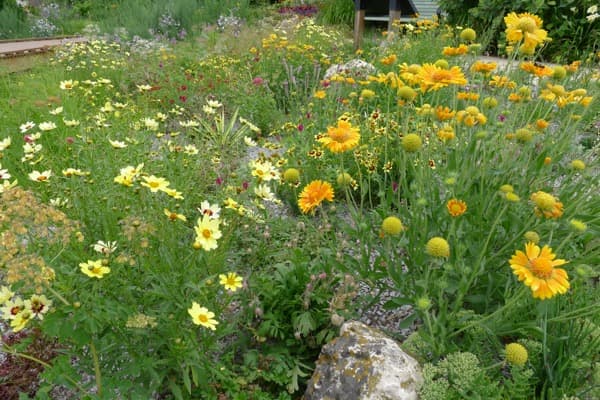
Rock mulch with native plants — a low-water, low-maintenance approach that suits Denver's climate perfectly.
Types of Rock Used in Denver Landscaping
Not all rock is created equal. Choosing the right type makes a significant difference in both aesthetics and function.
Decomposed Granite (DG)
Finely crushed granite that compacts into a stable surface. Popular for paths, driveways, and as a base layer under plants. Natural tan/brown tones blend well with native plantings. Affordable and easy to work with. One of the most common xeriscape mulches on the Front Range. Available stabilized (adds a binder for firmer paths) or unstabilized.
River Rock
Smooth, rounded stones ranging from pea-size to fist-size. Excellent for dry creek beds, drainage swales, and accent areas. More expensive per ton than DG but creates a distinctive look. Works best as an accent rather than wall-to-wall coverage.
Mexican Beach Pebble
Dark, smooth, polished stones. Used for modern and contemporary designs. Premium price but striking visual impact. Best in smaller accent areas — covering a full yard in Mexican beach pebble is expensive and can look overwhelming.
Crushed Flagstone / Buff Flagstone
Angular crushed pieces of flagstone in warm tan and orange tones. More textured than DG, less formal than river rock. Excellent all-around xeriscape mulch. Stays in place well on slopes. Very popular in Denver for a natural Front Range aesthetic.
Lava Rock
Lightweight, porous, dark red-brown. Dramatic appearance. Retains heat — can actually stress plants in hot summer beds if placed too close to crowns. Best used in accent areas away from plant crowns.
What to Avoid
White or bright gravel in sunny Denver yards throws glare and reflected heat back at the house and plants. Pea gravel without edging migrates constantly. Very fine sand-like materials compress and become impermeable to water over time.
One special case: the strip between the sidewalk and the curb. It's city right-of-way with its own rules, and in Denver the published standards don't allow gravel as permanent groundcover there — our hellstrip landscaping guide covers what does work.
Rock Landscaping Cost in Denver
Rock landscaping costs vary based on material type, depth, site prep, and whether plants and irrigation are included. Here's how our installed pricing works:
| Scope | Our installed price |
|---|---|
| Rock + plant xeriscape (most projects) | from $6/sq ft, typically $6–10/sq ft |
| Premium, heavy-boulder designs (our Outback theme) | $8–12/sq ft |
| Design fee | $500, credited toward installs over $5,000 |
For scale: a 500 sq ft front yard at $6–10/sq ft runs about $3,000–5,000; a 1,000 sq ft yard about $6,000–10,000. For a full cost breakdown including drip irrigation and plants, see our complete Denver xeriscape cost guide.
The Landscape Fabric Question
Landscape fabric under rock has a mixed reputation — and for good reason. When installed correctly under thick rock (3+ inches), woven fabric does suppress weeds for the first several years. But over time, soil works up through the fabric, weed seeds germinate in that soil layer, and the roots thread through the fabric making removal difficult.
The better long-term solution for weed suppression is sufficient rock depth (3–4 inches of DG or 3 inches of larger rock) combined with pre-emergent herbicide applied annually in spring. This is what we recommend at Xeris Landscaping for most projects.
Design Principles That Make Rock Landscaping Look Great
The difference between rock landscaping that looks intentional and designed versus rock landscaping that looks like someone poured gravel and walked away comes down to a few key principles.
Plants First, Rock Second
Rock is a mulch. Its job is to suppress weeds, retain moisture, and frame plants — not to be the star of the show. Projects that go heavy on rock and light on plants tend to look bare and harsh. A good rule: plan at least 30–40% of the bed area as planted space, with rock filling the rest.
For plant ideas that pair well with rock, see our top native plants for Denver xeriscape guide.
Layer Rock Sizes
Using one size of rock throughout looks flat. The best rock landscapes layer sizes: smaller DG or pea gravel as the ground cover, medium river rock as accents, and larger boulders as focal points. The size variation creates depth and visual interest.
Use Boulders Intentionally
One or two well-placed boulders (12–24 inches) can anchor a planting bed and give the design a sense of permanence and scale. Boulders should look like they belong — partially buried, oriented naturally, positioned to create a composition with the plants around them.
Define Edges Clearly
Clean, defined edges between rock beds and any adjacent hardscape, lawn, or pathways are what separate a professional installation from a DIY job. Steel edging, concrete banding, or natural flagstone borders all work well. Without defined edges, rock migrates and the design reads as unfinished.

Boulders, layered rock sizes, and native plants — the combination that makes rock landscaping look designed, not dumped.
Maintenance: What Rock Landscaping Actually Requires
One of the biggest misconceptions about rock landscaping is that it's truly zero maintenance. It's not — but it's dramatically lower than a lawn.
- Weeding: Even with rock, weeds find a way — particularly in the first 1–2 seasons. Annual pre-emergent application in April and hand-pulling after rain events keeps it manageable.
- Top-dressing: Rock settles and compresses over time, particularly in high-traffic areas. A light top-dress every 2–3 years keeps the depth consistent.
- Drip system checks: If plants are part of the design (they should be), the drip system needs spring inspection. See our seasonal xeriscape maintenance guide.
- Leaf and debris removal: Rock beds catch leaves and debris. A leaf blower in fall makes quick work of it — easier than raking a lawn.
Get a Rock Landscaping Estimate
Xeris designs and installs rock landscapes across Denver and the Front Range — front yards, backyards, slopes, and full lot conversions, with decomposed granite, boulders, and flagstone integrated with native plants and drip irrigation.
Request an estimate and we'll walk your site and price it.