

Denver Hellstrip Landscaping: Designing the Strip That Kills Everything
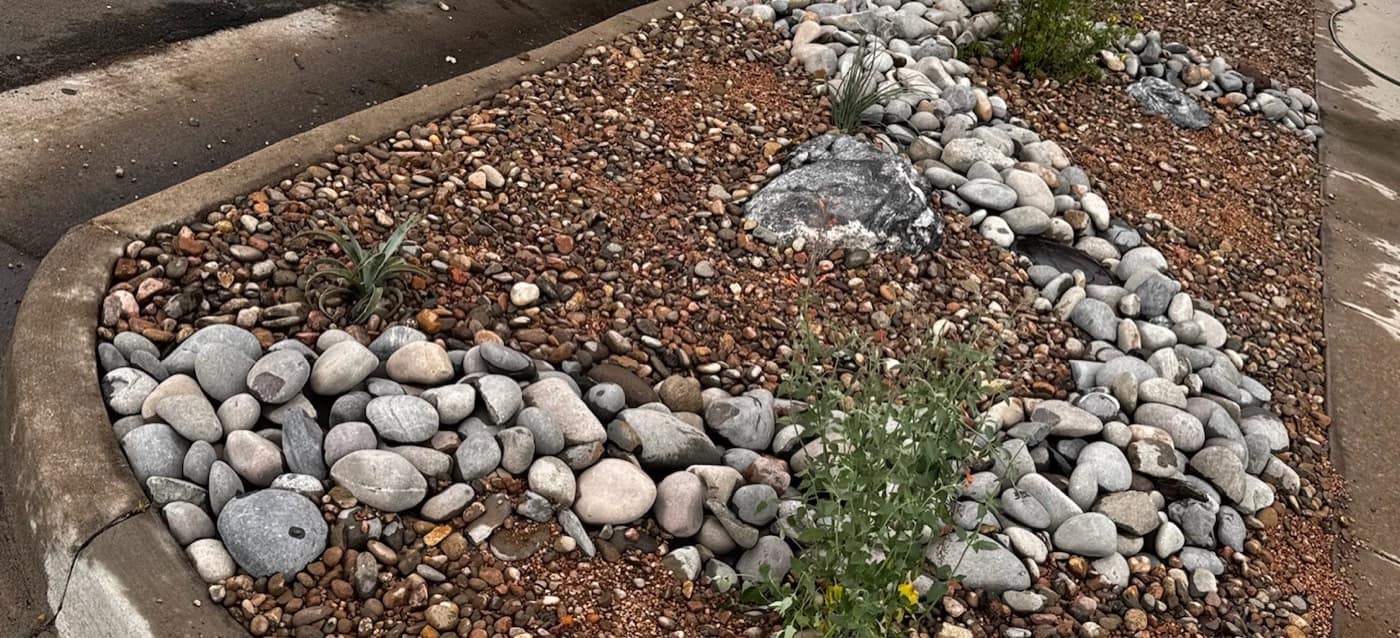
There's a strip of dirt between your sidewalk and the street. It bakes in July. It gets walked on, salted in winter, and ignored the rest of the year. It's too narrow to mow comfortably and too exposed to keep anything alive without a fight.
It has a name: the hellstrip. And we love designing them.
Most landscapers skip over it or throw in some sod and call it done. At Xeris, the hellstrip is one of our favorite spots on a property — because when it's done right, it changes the curb appeal of the whole house and tells the street exactly who lives there. It's a plant installation job first: the right plants, in fixed-up soil, spaced to fill in.
Why It's Called a Hellstrip
The name isn't dramatic — it's accurate. The hellstrip sits between two heat-absorbing surfaces: the street on one side, the sidewalk on the other. In a Denver summer, that pavement radiates heat from both directions, pushing ground temperatures well above air temperature. It's the horticultural equivalent of a double oven.
Add to that: compacted soil from foot traffic, dog use, delivery trucks bumping the curb, and zero supplemental irrigation in most cases. The hellstrip gets whatever water nature provides — which in Denver averages about 14 inches per year — and nothing more.
Grass doesn't stand a chance. Not sustainably, anyway. You can keep it alive with enough water and effort, but you're fighting the environment every single day. In 2026 you may not even get the water: under Denver Water's Stage 1 drought rules, watering grass is prohibited from Oct. 1, 2026, while trees, shrubs and other plants can still get hand-watering or drip (Denver Water drought rules). The homeowners who get the most out of their hellstrip are the ones who stop fighting it and start designing with it.
Why Denver Hellstrips Are Uniquely Brutal
Denver's climate throws a specific combination of punches at the hellstrip that most parts of the country don't deal with simultaneously:
- High altitude UV — At 5,280 feet, UV radiation is significantly stronger than at sea level. Plants that look fine in a Seattle or Chicago hellstrip will bleach and burn in a Denver one.
- Relentless sun — Denver's famous sunshine is great for solar panels. For unirrigated soil, it means accelerated evaporation and faster dry-down between rain events.
- Winter road salt and sand — City plows and de-icing crews treat the street, and that salt splash migrates into the hellstrip soil. Over years, it raises soil salinity and kills plants that would otherwise be perfectly hardy here.
- Hard freeze + rapid thaw cycles — Denver doesn't have a steady winter. We get polar vortex cold snaps followed by 65-degree days in January. That freeze-thaw cycle heaves roots and stresses shallow-planted material severely.
- Clay-heavy native soil — Denver's soil is predominantly compacted clay, which drains poorly, heaves in freeze-thaw, and bakes to near-concrete hardness in summer.
Any plant going into a Denver hellstrip has to survive all of this — not just one or two of these conditions. That narrows the list considerably. But the plants that do make it? They're beautiful, low-maintenance, and tough enough to last for years without attention.
What We Do Differently
The default hellstrip treatment in Denver is one of two things: dead grass or a flat layer of river rock with nothing growing. We don't do either.
Our approach starts with the soil. Before anything goes in, we amend the existing clay with compost and coarse grit to create drainage. Compacted clay that holds water in spring and cracks in summer is the silent killer of most hellstrip plantings. Fix the soil first, and the plants have a fighting chance.
From there, we design for three layers:
- Ground cover base — dense, low groundcovers doing the work of a surface, with mulch between young plants until they knit together. Where the city allows it (see the rules below — Denver's published standards don't), decomposed granite or crushed gravel can fill the gaps: it reflects less heat than dark rock, suppresses weeds, and looks clean between plants.
- Accent boulders — a few well-placed river rocks or fieldstone add visual weight, break up the linear strip, and protect plant crowns from foot traffic and mower drift.
- Adapted plant material — low-growing, deep-rooted natives and adapted perennials spaced to grow into each other over 2-3 seasons. We plant small and let them establish, rather than overcrowding at install and creating competition.
The result looks intentional — because it is. A hellstrip done right looks like a design decision, not an afterthought.
Plants That Actually Survive a Denver Hellstrip
This list isn't about what's pretty in a catalog. It's about what holds up in a south-facing, road-adjacent, Zone 6a strip that gets walked on and ignored. These are the plants we actually specify on hellstrip projects:
- Blue Grama Grass (Bouteloua gracilis) — Colorado's state grass. Drought-tolerant to an extreme, goes dormant in dry stretches rather than dying, and has that distinctive eyelash seedhead that looks great even in winter.
- Catmint (Nepeta faassenii) — One of our most-used hellstrip plants. Soft blue-purple bloom from late spring through fall, aromatic foliage that deer and dogs tend to avoid, and tough as nails once established. Stays under 18 inches.
- Prairie Zinnia (Zinnia grandiflora) — Tiny yellow flowers, spreading habit, virtually indestructible in Denver's summer heat. A Colorado native that thrives in the exact conditions that kill everything else.
- Russian Sage (Perovskia atriplicifolia) — Tall, airy, silver-blue, and bulletproof. Blooms all summer, handles road salt better than most, and adds vertical interest to narrow strips without getting too wide.
- Penstemon / Beardtongue (Penstemon strictus) — A Colorado native that puts on a show of purple-blue blooms in early summer, then drops back to a tight basal rosette that takes up almost no space. Pollinators love it.
- Agastache / Hummingbird Mint (Agastache rupestris) — Heat-loving, drought-tolerant, and covered in orange or purple blooms from July through frost. Hummingbirds and bees are on it constantly.
- Creeping Thyme (Thymus serpyllum) — For the edges and gaps between rocks. Handles foot traffic better than almost anything, stays under 3 inches, and blooms pink-purple in early summer.
- Low-growing Sedum (Sedum kamtschaticum, S. acre) — Succulent groundcover that stores water in its leaves, spreads slowly, and looks good year-round. Tolerates compacted soil and road salt splash better than most perennials.
What we don't plant in hellstrips: anything that needs regular watering to look good, anything tall enough to block sight lines at a corner, and anything with aggressive runners that will spread into the sidewalk cracks. Inside Denver city limits, the height cap is tighter — see below — which moves taller picks like Russian sage and full-size penstemon to the yard side of the sidewalk.
For a deeper look at the full plant palette we use across Denver xeriscape projects, see our guide to the top native plants for Denver xeriscape.
Know the Rules Before You Dig
The hellstrip is technically city right-of-way — you maintain it, but you don't own it. That means there are rules, and they vary by municipality.
City of Denver: Property owners are responsible for maintaining the landscape in the right-of-way in front of their property, tree lawn included (Denver tree lawn guidance). Denver Forestry requires a permit before any pruning, planting, or removal of plant material in the public right-of-way (Denver Forestry permit requirements). And the city's Streetscape Design Manual — the 1993 standard DOTI still publishes — doesn't allow gravel, bark, wood chips, or loose stone as permanent tree-lawn groundcover, and doesn't allow shrubs over 18 inches. Corner lots also have sight-triangle limits. That's why a Denver strip has to be plant-led, not rock-led.
Rebates: Denver Water's 2026 turf-removal offer — up to $750 off Resource Central's own turf-removal service, 200 sq ft minimum — is fully allocated and closed to new applications, and Resource Central's crews do that work themselves (Denver Water turfgrass removal). Watch for the 2027 program, and check Denver Water's current residential rebates.
Turf is out: Since Jan. 1, 2026, Colorado's SB24-005 bars local governments from allowing new nonfunctional turf, artificial turf, or invasive plants in street rights-of-way — and a hellstrip is street right-of-way. Don't re-sod it and don't put artificial grass there.
Colorado HOA law: Under C.R.S. 38-33.3-106.5, HOAs cannot prohibit xeriscape or drought-tolerant landscaping (statute text). They can still adopt reasonable design and aesthetic guidelines — plant type, number, placement, hardscape — so if your HOA has rules about the strip, you design within them. What they can't do is require live grass or ban drought-tolerant plants outright.
Outside Denver: Lakewood, Aurora, and the other metro cities each set their own right-of-way rules on plant height, materials, and permits. Check with your city before you dig.
When we scope a hellstrip project, we check the applicable municipal code before the design goes to the client. No surprises after installation.
Hellstrip Design Inspiration
We keep a running board of hellstrip and roadway strip ideas that inform how we design these spaces — everything from plant combinations and rock placement to corner lot treatments and narrow linear strips. Follow @xerislandscaping on Pinterest to see it.
The same logic scales up. Denver's medians and roadsides are one long hellstrip, and we've written about what the city's roadsides could look like if they were planted for this climate.
If you want to talk through what would work on your specific strip — corner lot, narrow linear, or a challenging grade — reach out and we'll take a look. Hellstrips are one of our favorite problems to solve.
Ready to Fix Your Hellstrip?
We design and install hellstrip plantings across Denver and the Front Range. Tell us what you're working with and we'll put together an estimate.