

Xeriscape Colorado: The Complete Guide to Low-Water Landscaping on the Front Range
Colorado gets about 14 inches of precipitation a year. Most of that falls as snow, mostly in the mountains, mostly not in your yard. What lands on the Front Range — in Denver, Colorado Springs, Fort Collins, Boulder, Pueblo — is closer to 12 inches annually. That's a semi-arid climate. Less water than Phoenix gets. Less than Tucson.
And yet most Colorado yards are planted like it's Ohio: bluegrass lawns that need 30–40 inches of water a year to survive, irrigated heavily from spring through fall, burning through water that increasingly doesn't exist. The 2026 drought has made that math visible to everyone. But the math was never good.
Xeriscape is the answer that actually fits Colorado — not as a compromise, not as a last resort, but as the right design approach for the climate you actually live in. This is the complete guide to what it is, how it works, and what it takes to do it right on Colorado's Front Range.
What Xeriscape Actually Is
Xeriscape is a landscaping approach built around water efficiency — using plants adapted to your local climate, efficient irrigation, and design principles that minimize water demand without sacrificing a usable, attractive yard. The term was coined by Denver Water in 1981, which makes Colorado the literal birthplace of the concept.
It's not a specific look. It's not gravel and cactus. It's not a brown yard with rocks scattered around a dead agave. Those are failed xeriscapes, or no xeriscape at all.
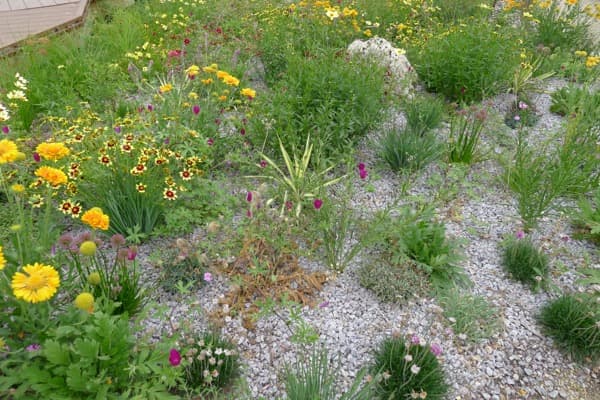
A well-designed xeriscape in Colorado looks like a landscape that belongs here — native grasses moving in the wind, flowering perennials from April through October, boulders and flagstone that give it structure, a drip system running on a long interval. It uses 50–75% less water than a bluegrass lawn and, once established, requires a fraction of the maintenance.
Denver Water's seven principles of xeriscape — planning and design, soil improvement, appropriate plant selection, practical turf areas, efficient irrigation, use of mulches, and appropriate maintenance — are as relevant to a Colorado Springs bungalow or a Fort Collins ranch as they are to a Denver suburb. The climate is the same across the Front Range. The solution is the same.
Colorado's Right-to-Xeriscape Law: What Homeowners Need to Know
One of the most common concerns Colorado homeowners raise before starting a xeriscape project is their HOA. The worry is legitimate — HOAs have historically been gatekeepers of what a yard is "supposed" to look like, and plenty of homeowners have been told their xeriscape plans wouldn't be approved.
Here's what the law actually says: HOAs in Colorado cannot prohibit water-efficient landscaping. Colorado passed HB 10-1278 in 2010, codified as C.R.S. § 38-33.3-106.4, which explicitly bars homeowners associations from banning xeriscape or drought-tolerant landscaping. The law was strengthened further in 2022 under HB22-1239, which tightened the restrictions on HOA interference with water-wise landscaping choices.
That doesn't mean your HOA has zero say. They can still require that your xeriscape meet certain aesthetic standards — it has to look intentional, maintained, and appropriate for the neighborhood. They can require approval of your design before you install. What they cannot do is reject a well-designed xeriscape simply because it doesn't have grass.
If you're in an HOA and planning a xeriscape project, the practical approach is: submit a design plan before starting, reference the statute if you receive pushback, and make sure your design is clean enough that "it looks unmaintained" isn't a valid objection. A professionally designed and installed xeriscape is nearly impossible to block under current Colorado law.
Colorado's Climate: What You're Actually Designing For
Front Range Colorado sits in USDA Hardiness Zone 5b to 6a, depending on elevation and microclimate. Denver proper is Zone 6a. Colorado Springs runs Zone 5b. Higher-elevation suburbs — parts of Lakewood, Evergreen, the foothills communities — can dip to Zone 5a. That's your cold tolerance baseline: plants need to survive down to -10°F to -20°F in a bad winter.
But cold hardiness is only part of the equation. The more defining characteristic of Front Range climate is the combination of heat, sun intensity, low humidity, and wind. At 5,280 feet and above, UV radiation is significantly stronger than at sea level. Summers bring heat spikes into the 90s with almost no humidity and regular afternoon wind. Clay soil dominates most Front Range residential lots — it compacts, drains poorly, and creates wet-dry cycles that stress plants adapted to more consistent conditions.
The plants that actually thrive here evolved with all of it: the cold winters, the dry summers, the intense sun, the clay soil, the hail. Colorado's native flora — blue grama grass, native sedums, Apache plume, rabbitbrush, penstemons, blue flax, prairie sage — are built for exactly these conditions. They don't need to be managed through them. They thrive in them.
Designing a xeriscape for Colorado means leaning into that native plant palette, choosing species with proven front-range performance, and building a system — irrigation, mulch, soil amendment — that supports establishment without creating a maintenance dependency.
The Best Xeriscape Plants for Colorado
The strongest xeriscape plant palettes for Colorado mix native species with well-adapted non-natives — plants that may not be from Colorado's ecosystem specifically but that perform identically once established. Here's what works across most Front Range yards:
Grasses and groundcovers
Blue grama (Bouteloua gracilis) is the Front Range's workhorse native grass — short, drought-tolerant, and technically the Colorado state grass. Buffalo grass performs similarly for low-traffic areas. For ornamental value, Karl Foerster feather reed grass and native switchgrass add height and movement. Prairie dropseed works well as a fine-textured groundcover alternative to turf.
Flowering perennials
Rocky Mountain penstemon (Penstemon strictus), blanket flower (Gaillardia), native salvia, black-eyed Susan, prairie coneflower (Ratibida), and catmint (Nepeta) are reliable bloomers from late spring through fall. Purple coneflower (Echinacea) does double duty — long bloom season and wildlife value. For early spring color, blue flax (Linum lewisii) is nearly impossible to kill once established in Colorado soil.
Shrubs and structure plants
Apache plume (Fallugia paradoxa) is one of the most underused plants in Colorado xeriscape — wispy white flowers followed by feathery seed heads, tolerates almost any Front Range condition. Rabbitbrush (Ericameria nauseosa) blooms brilliant yellow in September when most perennials are done. Native three-leaf sumac provides fall color and is essentially maintenance-free. Fernbush (Chamaebatiaria millefolium) adds fine texture and fragrance in mid-summer.
Trees for canopy
Gambel oak is the slow-play choice — a native that eventually provides excellent drought-tolerant canopy and fall color. For faster establishment, native hackberry and plains cottonwood (along water features only) perform well. Ornamental choices like desert willow (Chilopsis linearis) bring big color and handle Colorado conditions without irrigation after year two.
For a deeper plant list, see our complete native plants guide for Denver xeriscape — the same plant palette applies across the Front Range.
Water Rebates for Xeriscape in Colorado
Multiple Colorado water utilities offer cash rebates for converting turf to xeriscape — and the programs have gotten significantly more generous as the drought situation has deepened. The money is real and worth understanding before you budget a project.
Denver Water runs the most comprehensive rebate program in the state. Their Xeriscape Incentive Program offers up to $2.00 per square foot of turf removed and replaced with water-wise landscaping, with no cap on the rebate amount. A 1,000 square foot lawn conversion can return $2,000 toward your project cost. Drip irrigation upgrades carry an additional rebate of $50–$100. Denver Water also offers free xeriscape workshops and a plant selector tool at denverwater.org.
Colorado Springs Utilities offers turf buyback rebates through their Water Conservation program. Fort Collins Utilities runs a Water Efficiency Program with tiered rebates for turf removal. Aurora Water, Centennial Water, Littleton/Englewood Wastewater, and most other Front Range utilities have some form of water-wise landscaping incentive — the specifics vary, so check directly with your provider.
A practical note: most rebate programs require pre-approval before you start work. You apply, they may inspect the existing turf area, and then you convert and apply for the rebate after completion. Don't skip the pre-approval step or you may not qualify. For a detailed walkthrough of Denver Water's program specifically, see our Denver xeriscape rebates guide.
What Xeriscape Costs in Colorado
The honest range for a professionally designed and installed xeriscape on a Colorado Front Range lot is $8–$20 per square foot, depending on scope, plant density, hardscape elements, and irrigation. A typical 1,500 sq ft front yard conversion runs $12,000–$25,000 fully installed. A full-property redesign with design, demo, hardscape, plants, and drip irrigation can run significantly higher.
That number needs context before it lands wrong. A bluegrass lawn costs $600–$1,200 per year to irrigate in Denver's climate. It needs fertilization, aeration, overseeding, and mowing maintenance on top of that. Over ten years, you'll spend $8,000–$15,000 just running the lawn you already have. The xeriscape doesn't have those ongoing costs — after establishment (typically one to two seasons), water use drops to near nothing and maintenance drops to a few hours of seasonal cleanup per year.
Rebates change the math further. A Denver Water rebate of $2/sq ft on a 1,000 sq ft conversion returns $2,000 directly — effectively reducing your installation cost by 10–20% on a mid-size project.
For a full breakdown of how xeriscape pricing is calculated and what to expect at different budget levels, see our complete xeriscape cost guide for Denver.
How to Start a Xeriscape Project in Colorado
The process for a professional xeriscape installation on the Front Range follows a consistent sequence. Understanding it before you start avoids the most common mistakes homeowners make — particularly around timing, rebates, and HOA approval.
Step 1: Design first. A xeriscape lives or dies by its design. Plant placement, irrigation zones, drainage, hardscape layout — these decisions compound. Getting them wrong in execution costs significantly more to fix than getting them right upfront. Work with a designer who knows Front Range conditions specifically, not a generic landscaper with a good portfolio from somewhere else. Our xeriscape design guide covers what the design process looks like and what to expect from a professional design engagement.
Step 2: Pre-approve with your HOA and water utility simultaneously. If you're in an HOA, submit your design for review before demo begins. At the same time, contact your water utility to pre-qualify for rebates. Both processes are straightforward but sequential — you can't do them after the fact.
Step 3: Time the installation right. Colorado has two strong planting windows: late April through June, and September through mid-October. Spring is peak contractor season and books out fast. Fall is often the better window for woody plants and shrubs — roots establish over winter and the plant takes off faster the following spring.
Step 4: Budget the establishment year. Even the most drought-tolerant plants need irrigation during their first growing season to establish root systems. Plan for regular watering in year one — typically via drip irrigation on a longer interval than a traditional lawn — then taper off. By year two, most Colorado native plants need minimal supplemental water.
Step 5: Maintain minimally but consistently. An established xeriscape needs a spring cleanup (cut back dead material, pull early weeds before they seed), occasional drip line checks, and a fall cleanup. That's the bulk of it. Compared to a lawn, it's a fraction of the time and cost.
Ready to Replace Your Colorado Lawn?
Xeris designs and installs xeriscapes across Denver, Lakewood, Aurora, Arvada, Centennial, and the broader Front Range. We handle design, permitting, demo, installation, and irrigation — and we know Colorado's rebate programs. Request an estimate and we'll walk you through exactly what your yard needs and what it costs.