

Hardscaping & Patios in Denver
Flagstone and paver patios, decomposed granite paths, retaining walls, and boulder work — built on a base that survives Front Range freeze-thaw.
- Compacted base in lifts — the reason a patio is still flat after ten Denver winters
- Positive drainage designed in, so water leaves the patio and the foundation
- Local stone: Colorado buff, Lyons red, and Front Range granite that belongs here visually
- Decomposed granite paths stabilized properly, so they don't wash out in a summer storm
- Retaining walls and boulder placement engineered for the grade, not just stacked
Get a free estimate
Tell us what you’re working with. We’ll walk the property and give you a real number.
What’s included
Layout staked on site so you can walk the footprint before we excavate.
Excavation to depth with base compacted in lifts and laser-checked for grade.
Positive slope away from structures — typically a quarter-inch per foot minimum.
Stone, paver, or DG surface set with proper joints, edge restraint, and stabilizer.
Retaining walls with drainage behind them: gravel backfill and drain line, not just a wall.
Cleanup, and a walkthrough on sealing, joint maintenance, and what to expect seasonally.
Our concrete and hardscape work starts at $8 per square foot, and recycled-concrete options start at $4. Natural flagstone, mortared stone, and pavers sit above that minimum depending on material and access, and retaining walls price by face foot based on height and drainage. We give you a real number after walking the site.
The base is the project
A patio is a base with stone on top. Everything that goes wrong with hardscape in Denver — the settling, the rocking pavers, the cracked flagstone joints, the wall that bellies out in year four — traces back to what's underneath.
Front Range freeze-thaw is punishing. The ground heaves and drops repeatedly through winter, and clay soil amplifies it. A base excavated to proper depth and compacted in lifts absorbs that movement. A base that was dumped in one pass and rolled once does not, and the surface telegraphs every bit of it.
This is the part of a hardscape bid you cannot see and the part that determines what you actually bought. It's also the first thing cut when a number needs to come down.
Drainage is designed, not hoped for
Every hardscape surface changes where water goes. A patio without positive slope becomes a shallow pool that freezes; one sloped toward the house is worse than no patio at all.
We build in a minimum quarter-inch-per-foot fall away from structures, and we deal with where that water lands — a dry creek, a swale, a drain, or a planted bed built to take it. Retaining walls get gravel backfill and a drain line behind them, because hydrostatic pressure is what pushes walls over, not the soil weight people assume.
Material, honestly
Flagstone — Colorado buff, Lyons red, and similar local stone look right against Front Range architecture and weather beautifully. Most expensive, needs a skilled setter, and irregular stone takes time to fit well.
Pavers — the most durable and predictable option, and the easiest to repair since you can lift and reset individual units. The right answer for driveways and anything taking heavy traffic.
Decomposed granite — inexpensive, permeable, and the correct material for paths and informal seating. It needs a stabilizer and proper edging or it migrates, and it's a poor choice on slope or under rolling furniture. For DG and rock as groundcover rather than a patio surface, see rock & decomposed granite.
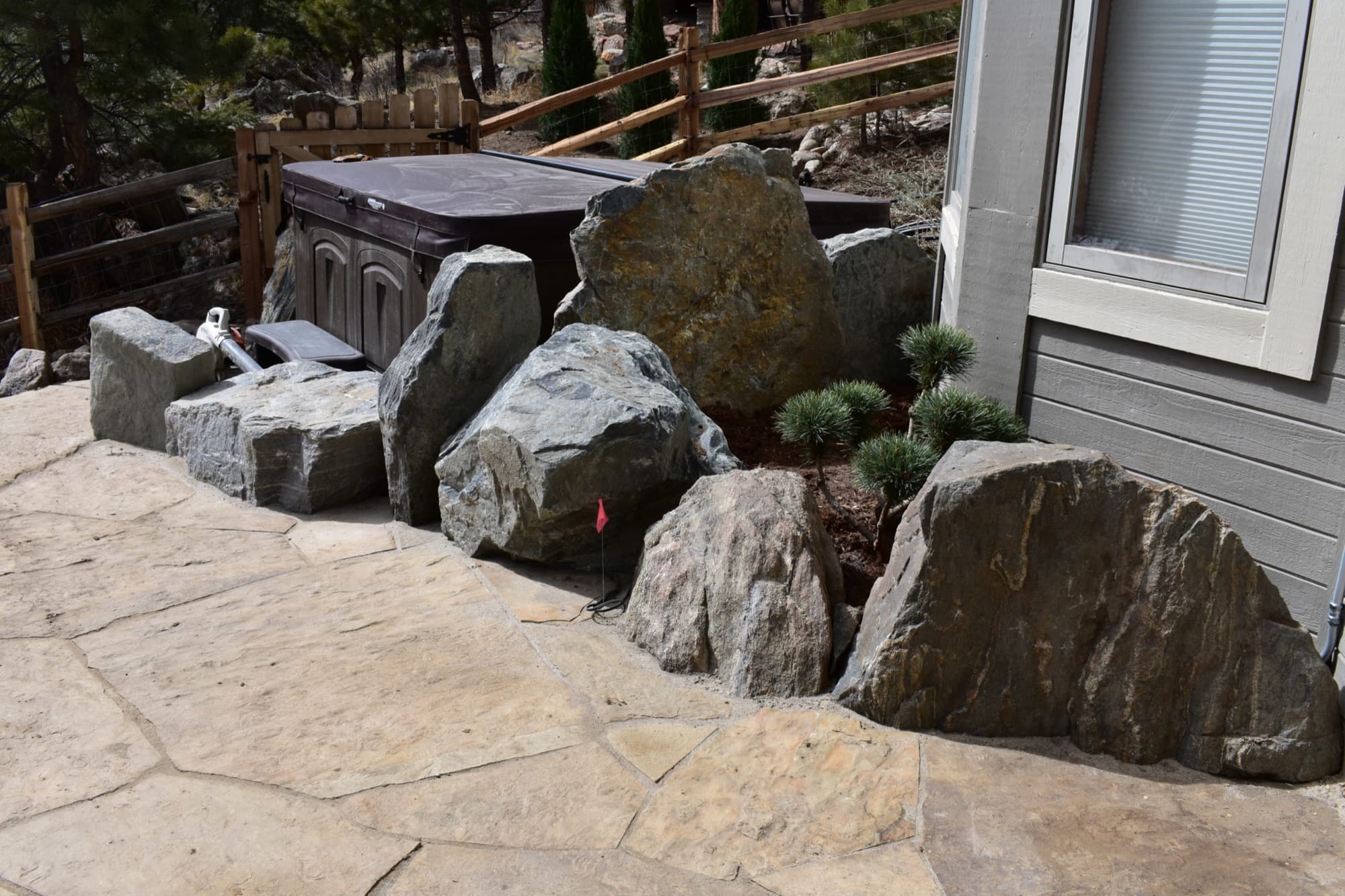
Boulders — placed, not dropped. Buried to roughly a third of their height so they read as outcrop rather than ornament. Set wrong, a boulder looks like it was delivered; set right, it looks like the house was built around it.
Outdoor living
Patios, seating walls, fire features, hot tub surrounds, and the grade work that makes a sloped Denver backyard usable. The boulder and flagstone work above is a typical example — stone doing structural work and looking like it grew there.
Hardscape pairs directly with fences and structures for shade and enclosure, and with planting to keep the space from reading as a parking lot.
Common questions
- Flagstone, pavers, or decomposed granite — which should I use?
- Flagstone gives the most natural look and suits Front Range architecture, but it's the most expensive and needs a skilled setter. Pavers are the most durable and predictable, best for driveways and high-traffic patios, and easiest to repair since you lift and reset individual units. Decomposed granite is the cheapest and works beautifully for paths and informal seating areas — just not on slopes where it'll wash, and not where you want to roll furniture.
- Why do patios in Denver crack or go uneven?
- Almost always the base. Freeze-thaw here is severe — ground heaves repeatedly through winter — and an under-compacted or too-shallow base lets that movement telegraph straight through the surface. A base built in compacted lifts to the right depth absorbs it. That work is invisible and it's most of the cost, which is exactly why cheap bids skip it.
- Do I need a permit for a patio or retaining wall?
- Patios at grade usually don't. Retaining walls over a certain height — commonly four feet in Denver-area jurisdictions, sometimes lower — typically do, and may need engineering. Rules vary by municipality. We'll tell you what your specific project needs before we start.
- Does hardscape count against my water rebate?
- Often, yes. Most turf-replacement rebate programs require a minimum share of the converted area to be living plants and cap how much can be hardscape or gravel. If a rebate is part of your budget, the hardscape footprint needs to be planned against those rules from the start rather than discovered afterward.
- Can hardscape make my yard hotter?
- Large expanses of stone and gravel absorb and re-radiate heat, which is real at 5,280 feet in full sun. The fix is design, not avoidance: size the patio to how it'll actually be used, put shade over it, and surround it with planting instead of extending gravel wall to wall.
Read more
Decomposed granite landscaping
Decomposed granite in Denver — stabilized vs. unstabilized, cost per ton, how to install it right, and how to keep it weed-free long-term.
Rock landscaping in Denver
Rock landscaping in Denver — types, costs, design principles that separate great from mediocre, and what maintenance actually looks like.
Hellstrip landscaping
Denver hellstrips bake in summer, get salted in winter, and get walked on year-round. Most plants fail. Here's how Xeris designs them to actually survive.
Xeriscape backyard ideas
9 xeriscape backyard ideas for Denver — designed around real use: dogs, entertaining, shade, drainage, and how you actually live in the space.
Landscape design in Denver
What landscape design in Denver includes, what a design costs ($500, credited on installs over $5,000), what you get, and how to choose a designer.
Low-maintenance landscaping
What low-maintenance landscaping actually looks like in Denver — native plants, drip irrigation, and rock mulch that cut annual upkeep to near zero.
Where we work
We’re Denver-based and work across the metro. Water rules and rebates depend on your provider — each city page covers yours.
Ready to get a number?
We design and build water-wise landscapes across the Denver metro. Free walkthrough, honest scope, no pressure.