

Artificial Turf in Denver: What We Actually Think (And Why We Install It Anyway)
Artificial turf is one of those topics where everyone has an opinion and most of them are oversimplified. It's either the savior of water-stressed yards or an ecological disaster, depending on who you ask. The truth, as usual, is more complicated than that — and as a company that installs both xeriscape and artificial turf across Denver, we've had to develop an honest position on it.
Here it is: artificial turf is not for everyone. It has real environmental trade-offs. And it's also a genuinely excellent solution for the right yard, the right family, and the right application — especially when you're thoughtful about materials and installation.
This article is our unfiltered take on artificial turf in Denver: what it's good for, where it falls short, how the industry is improving, and how we approach it when a client asks.
Why Denver Homeowners Are Thinking About Artificial Turf
Denver's relationship with grass has always been strained. We average 14 inches of precipitation a year — less than Los Angeles. Bluegrass lawns, the default for most Front Range neighborhoods, need 20–25 inches of moisture annually. That gap gets filled with irrigation water, which costs money, burns through Denver Water's allocation limits, and produces a lawn that looks stressed from July through September regardless of how much you water it.
Add in drought restrictions, escalating water rates, and the sheer time burden of mowing and maintenance, and it's no surprise that homeowners are asking questions about alternatives.
For some, the answer is native plant xeriscape — and for yards where the goal is beauty, ecological function, and low input, that's often the better choice. But for others — families with kids and dogs who actually want to use the grass, homeowners who want a putting green, clients who want a clean outdoor space that requires almost zero maintenance — artificial turf solves real problems that native plants don't.
What We Actually Install: Artificial Turf Applications in Denver
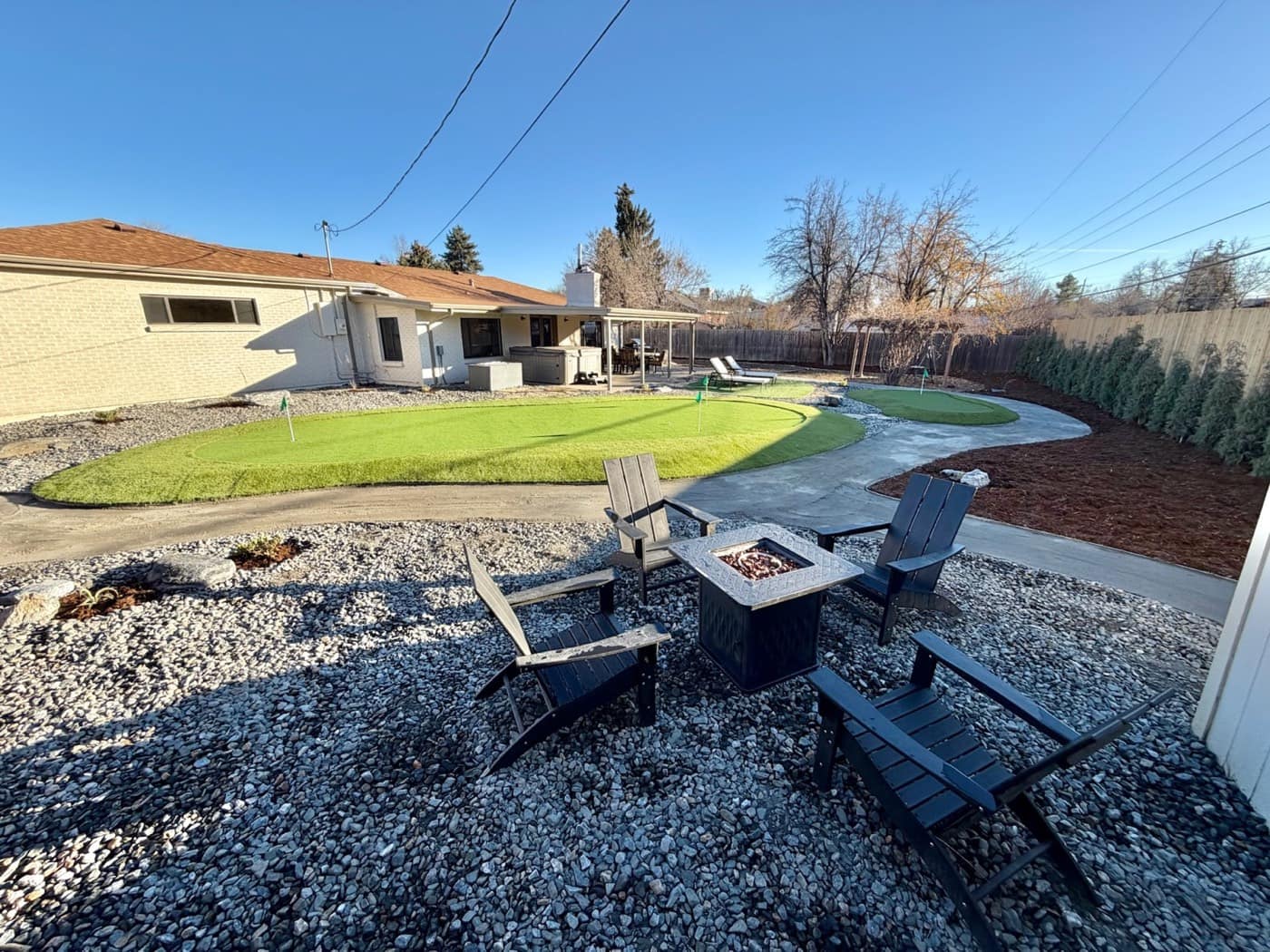
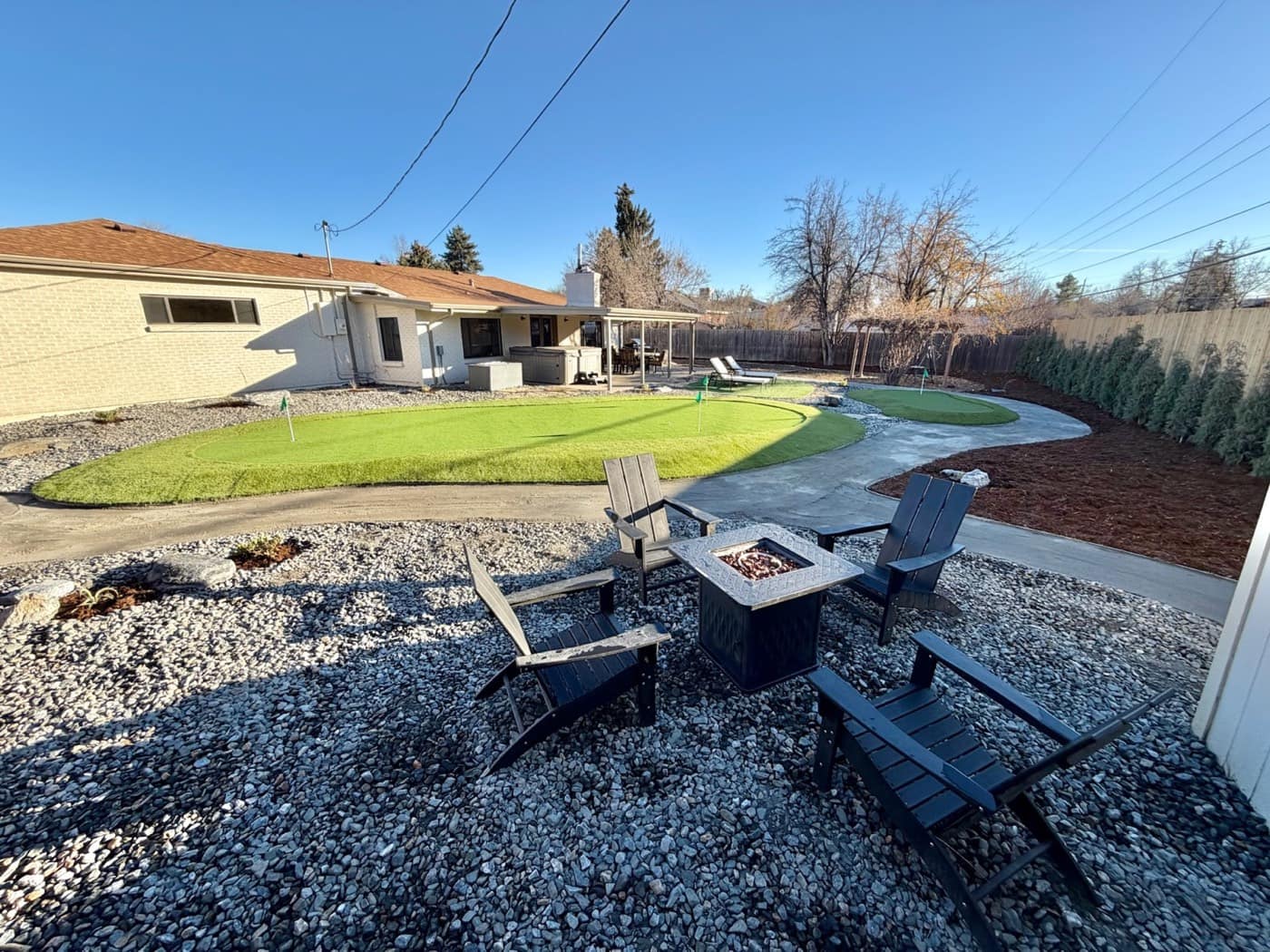
A completed Denver backyard — artificial turf putting green, fire pit seating area, and decomposed granite. Installed by Xeris Landscaping.
Not every artificial turf project looks the same. The applications we install most often in the Denver area:
Putting Greens
This is where artificial turf is genuinely hard to beat. A custom putting green — shaped to your backyard, with multiple hole positions, fringe turf, and proper base for true ball roll — creates a space that gets used constantly and requires almost nothing to maintain. No mowing, no watering, no browning in August. If you golf, this is one of the better investments you can make in your outdoor space.
Backyard Play and Family Areas
For families with kids, the math often makes sense. A 500–1,000 square foot section of soft, clean artificial turf — paired with a patio, raised beds, or a fire pit area — creates a year-round outdoor living space that holds up to heavy use without turning to mud. Kids can play on it in March when native grass areas are still dormant and soggy.
Dog Runs and Pet Areas
Dogs are hard on natural turf and native plantings. A dedicated artificial turf dog run with proper drainage solves the problem permanently — no dead patches, no muddy paws, no destroyed planting beds. High-quality pet turf products are designed specifically for drainage and odor resistance.
Low-Maintenance Lawn Replacement
Some homeowners simply want a yard that looks green year-round without the time commitment of a real lawn. For the right property — particularly in water-stressed areas or on difficult terrain — artificial turf as a lawn replacement makes practical sense. It's not our first recommendation for large-scale installations, but for specific contexts it works.
Commercial and HOA Properties
Entry areas, medians, and commercial spaces where appearance consistency matters throughout the year are strong candidates. Artificial turf at a building entry looks the same in January as it does in June, with no maintenance windows or seasonal variation in appearance.
The Environmental Trade-Offs — Honestly
We're not going to pretend artificial turf is a purely green choice. It isn't, and homeowners deserve a straight answer.
It's a synthetic product. Most artificial turf is made from polyethylene or polypropylene — petroleum-derived plastics. Manufacturing has a carbon footprint. At end of life (typically 15–20 years), older product lines often end up in landfill because recycling infrastructure hasn't kept pace with demand.
It gets hot. Artificial turf surfaces can reach 150–170°F in direct summer sun — significantly hotter than natural grass. This contributes to urban heat island effect and makes the surface unusable during peak heat without cooling infill or shade.
It doesn't support ecosystems. Unlike native plantings, artificial turf provides no habitat, no pollinator support, no soil biology. If your goal is to contribute to Denver's urban ecology, artificial turf doesn't help with that.
Infill materials matter. Older crumb rubber infill (made from recycled tires) has been the subject of ongoing research regarding PFAS and heavy metals. The industry has largely moved away from it for residential applications, but it's worth asking specifically what infill your installer plans to use.
These are real trade-offs. We name them upfront because homeowners making a $10,000–$25,000 investment deserve the complete picture, not a sales pitch.
How the Industry Is Improving — And the Brands We Pay Attention To
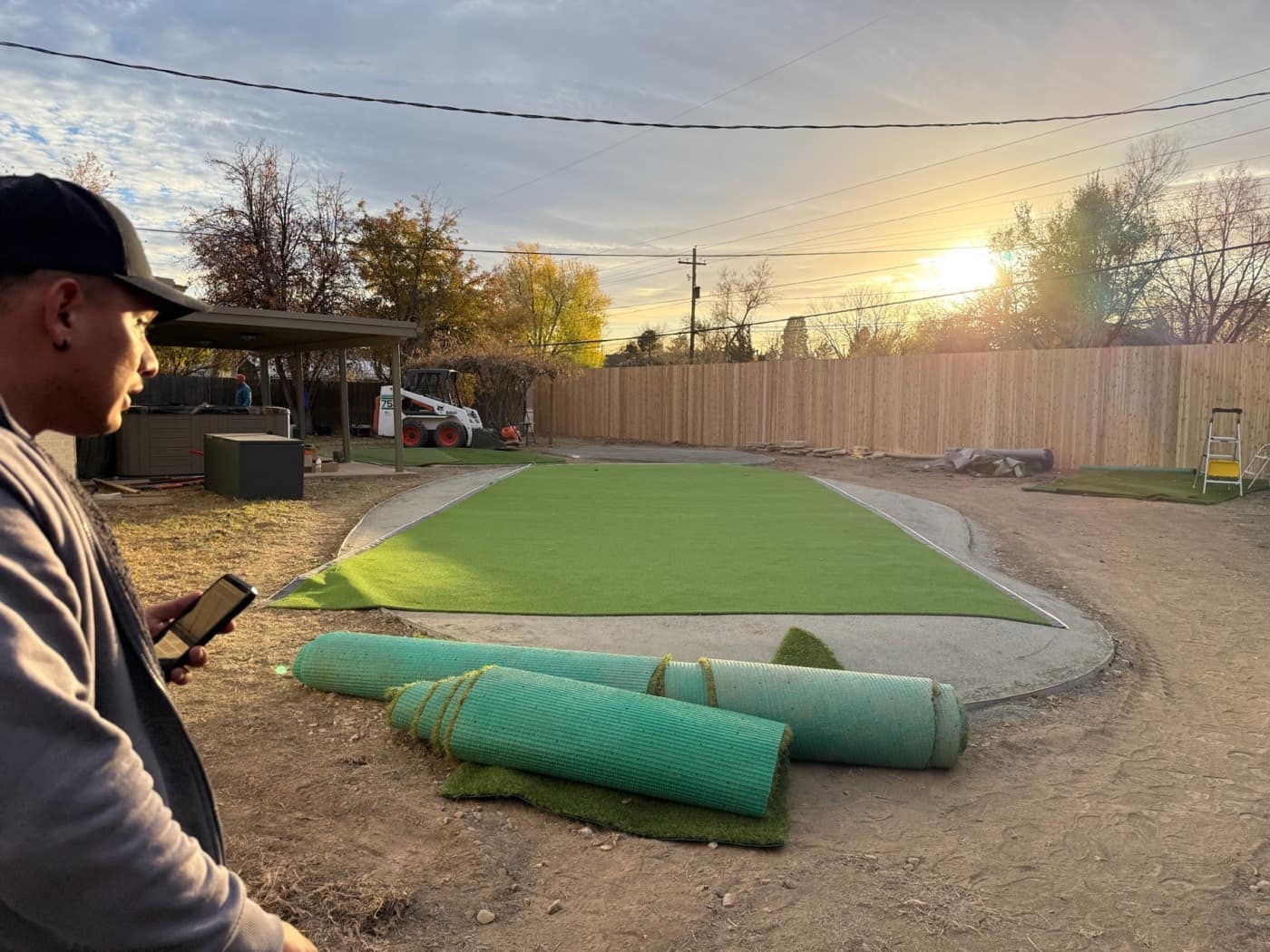
Artificial turf installation in progress at a Denver backyard — the base and drainage layer are as important as the turf itself.
The artificial turf industry is changing meaningfully, driven by consumer pressure and regulatory scrutiny — particularly around PFAS (per- and polyfluoroalkyl substances, sometimes called "forever chemicals"). Here are the manufacturers and product innovations we follow:
SYNLawn — Plant-Based Backing and USDA Certification
SYNLawn's EnviroLoc+ backing is made from 80% renewable content using soy-based materials, and the company holds USDA BioPreferred certification. Their systems can qualify for up to 24 LEED credits. SYNLawn Colorado operates locally and is one of the more credible eco-focused manufacturers serving the Front Range.
FieldTurf — PFAS-Free Verification
FieldTurf has pursued third-party lab verification for PFAS-free materials across their product lines and holds ISO 14001 environmental management certification. Their recently manufactured fibers contain no detectable PFAS — independently verified.
Global Syn-Turf — Denver-Local with PFAS Testing
Global Syn-Turf's Denver location offers PFAS-free product lines with independent lab testing. Having a local distribution hub means shorter supply chain and faster access to specific product specifications for Denver installations.
GreenPlay Organics — Natural Infill
Infill is often the overlooked variable in turf installations. GreenPlay's Corkonut infill — a blend of cork and coconut husk — replaces synthetic rubber infill with a 100% natural, recyclable material. Cork also stays cooler than rubber infill in direct sun, partially addressing the heat island concern.
The honest takeaway: the industry still has work to do on end-of-life recycling at scale, but the shift away from PFAS-containing materials and toward plant-based components is real and accelerating. Asking your installer specifically about PFAS certifications and infill materials is a reasonable and important question.
Our Position: The Compromise Is Worth It — When Done Right
At Xeris, our core belief is that outdoor spaces should enrich life — spaces where families connect, where kids play, where you actually want to spend time. A yard you love using, that doesn't demand your every weekend.
For some families, that means native plants and xeriscape — a landscape that looks like Colorado, supports local ecosystems, and improves every year. For others, it means a clean patch of artificial turf where kids can actually play in May without ruining their shoes, where dogs can run without destroying the landscaping, where a putting green turns the backyard into a place people actually gather.
We don't see these as opposing values. We see them as different expressions of the same goal: a yard that works for your life.
What we won't do is install artificial turf irresponsibly. That means specifying PFAS-free products. It means using natural infill where the project allows. It means being honest with clients about heat performance on south-facing installations. It means proper base preparation and drainage so the system lasts its full lifespan rather than failing early. And it means pairing turf areas with native plantings and hardscape so the overall landscape still has ecological value — turf doesn't have to be the whole story.
What to Ask Before Hiring Any Artificial Turf Installer in Denver
Whether you hire Xeris or someone else, these are the questions worth asking:
What products do you specify, and are they PFAS-free?
Any reputable installer should be able to name their turf manufacturer and confirm whether independent PFAS testing has been done. Ask for documentation. "PFAS-free" should be verified by a third-party lab, not just a marketing claim.
What infill do you use?
Crumb rubber infill from recycled tires is still common and cheaper than alternatives. Natural infill options — cork, coconut husk, silica sand — cost more but perform better from a heat and toxicity standpoint. Know what's going under the turf.
What does the base preparation look like?
Artificial turf lifespan and performance depend heavily on what's underneath. Proper excavation, compacted aggregate base, and drainage layer are what separate a 20-year installation from one that's failing at year 8. Ask specifically about the sub-base specification.
What's the warranty, and who backs it?
Most quality turf products carry 10–15 year product warranties. Your installer should also warranty the installation itself. Understand who you're calling in year 5 if there's a drainage issue.
Can you pair the turf with native plantings?
The best Denver artificial turf installations don't stand alone — they're integrated into a broader landscape design that includes native perennials, decomposed granite, hardscape, or other elements that give the yard ecological and visual depth. An installer who only thinks in turf is leaving most of the design value on the table.
Ready to Install Artificial Turf in Denver?
We design and install artificial turf across Denver and the Front Range — PFAS-free materials, proper base prep, and integration with xeriscape if that's what your yard needs. We'll give you a straight answer on whether turf makes sense for your situation.
Xeris does this work. See our Artificial Turf Installation service in Denver — what's included, what it costs, and how to get a free walkthrough of your property.