

Custom Putting Green Installation in Denver: What It Costs and What to Expect
There's one application where the question of whether artificial turf is worth it doesn't need any hedging: putting greens. No natural grass alternative — bentgrass, Bermuda, Poa annua — comes close for a residential backyard in Denver. Maintaining a real bentgrass putting green requires a specialized mower, frequent cuts, specialized agronomic inputs, and frankly a level of obsession most homeowners don't have. A well-installed synthetic putting green rolls consistently and requires almost no maintenance.
The catch is that putting green turf is not the same product as lawn turf, and putting green installation is not the same process as a standard turf install. Get those two things wrong and you have an expensive carpet that the ball skips across instead of rolls on. Get them right and you have a backyard amenity that actually works.
Xeris Landscaping builds custom putting greens across Denver and the surrounding metro. This is what real putting green installation looks like — what it costs, what it requires, and what separates a functional green from a waste of money.
What a Well-Built Backyard Putting Green Looks Like
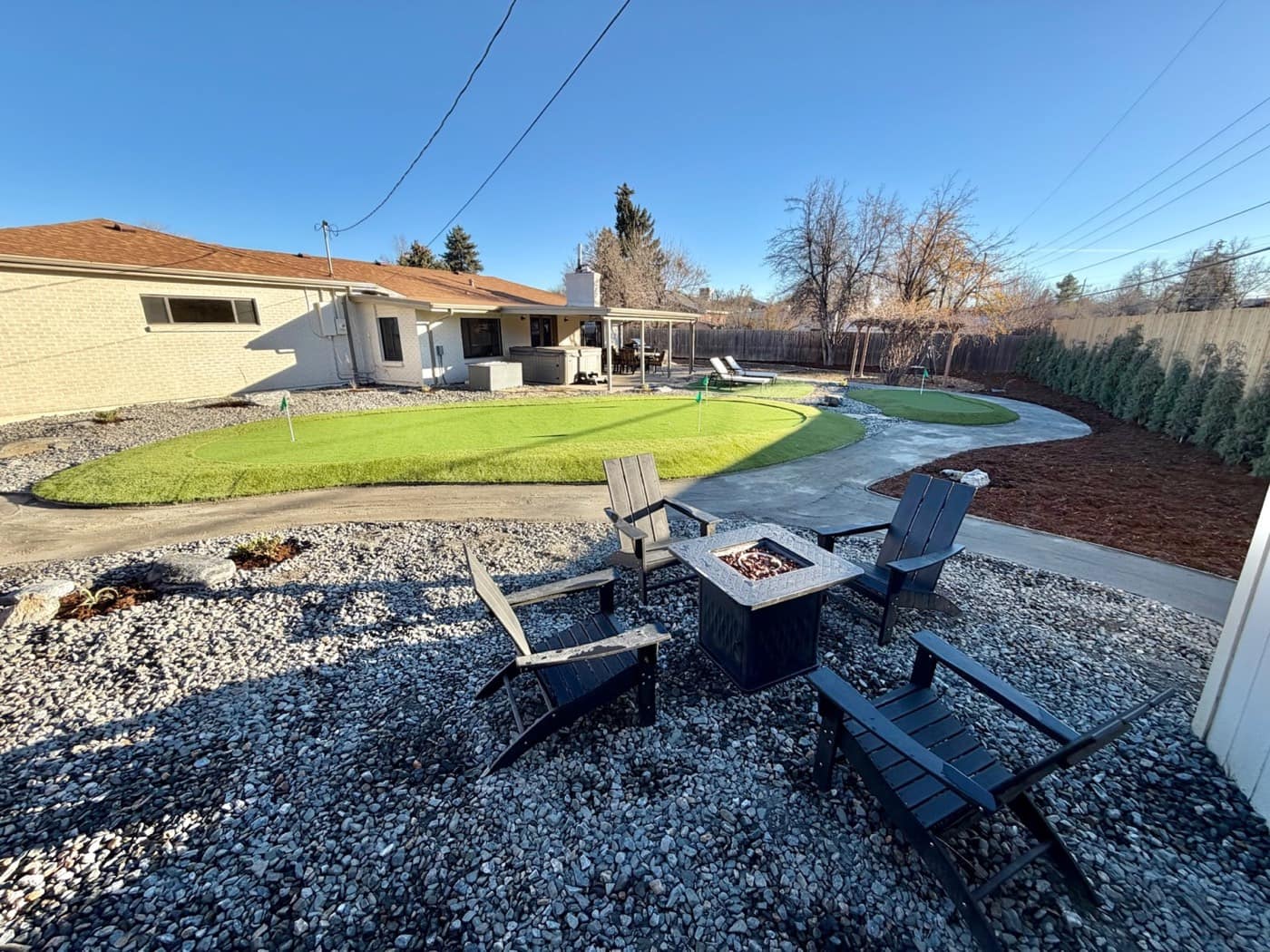
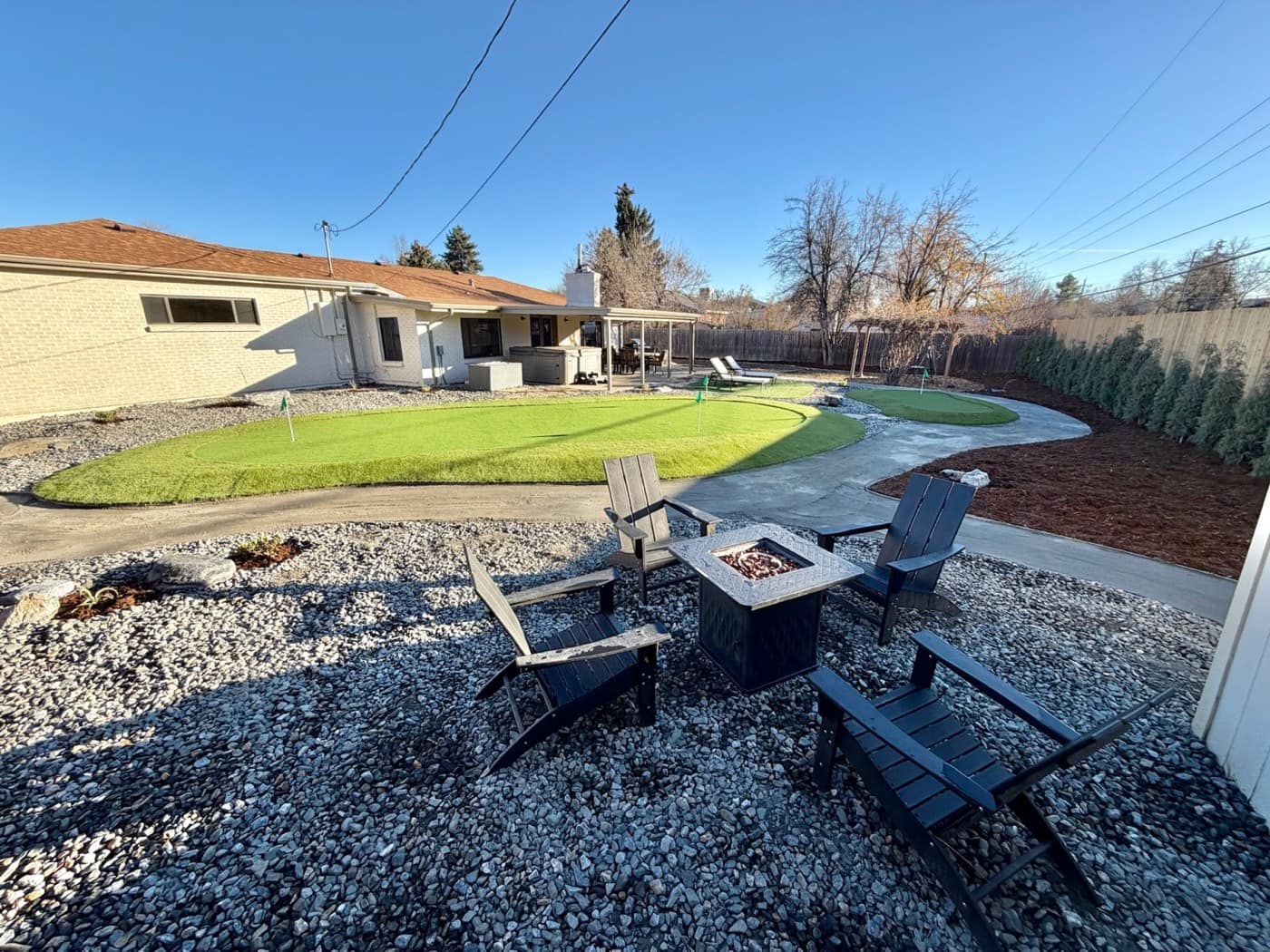
The green above shows the idea: a multi-hole putting surface integrated into a fully redesigned backyard. The green sits front and center, framed by decomposed granite borders that define the putting surface and create clean sightlines across the space. A fire pit area anchors the back, making the whole yard functional from multiple angles rather than just one vantage point.
A green like this uses a short-pile putting surface turf, a separate fringe turf at a slightly longer pile height ringing the perimeter, and DG surrounds that keep the look clean without adding material complexity. Hole cups are set flush to the surface. The shape has movement — it's not a rectangle dropped in the corner — which is what makes it read like a real putting green rather than a novelty add-on.
That integration is the difference between a putting green that adds value to a backyard and one that looks like an afterthought. The material palette — turf, DG, concrete, plantings — has to work together.
Design Options: What You're Actually Choosing
A putting green isn't a single product — it's a combination of decisions that stack up into the final result. Here's what you're configuring.
- Hole count and placement — Single-cup greens work at the smallest scale (under 250 sq ft) but feel limited fast. Two-hole is the practical sweet spot for most backyards — enough variety to make practice interesting without requiring a massive footprint. Three- and four-hole greens need 400–600+ sq ft to breathe properly. Hole placement is custom — we locate cups based on the shape of the green and where interesting angles occur, not a formula.
- Fringe turf and surrounds — Fringe turf is a separate turf product installed at a longer pile height around the perimeter of the putting surface — it's what gives a putting green its course-like look. Without it, the transition from green to hardscape is abrupt. Surround options beyond fringe include decomposed granite (most common — cost-effective and natural), concrete (cleanest finish), and pavers (premium). Each changes the maintenance profile and the visual character of the space.
- Ball roll speed (stimp rating) — Roll speed is a function of pile height and infill density. You can run a green faster with less infill, but on a small residential green that translates to putts that sail past the cup constantly. Slightly slower is the right call for most backyard applications.
- LED cup lighting (premium option) — Illuminated hole cups with low-voltage LED lighting are a premium add-on that makes the green usable at night. Not a functional necessity, but it's the detail that makes the space feel designed rather than installed. Cost depends on cup count and wiring complexity.

What It Actually Costs
Our artificial turf installs start at $10 per square foot installed, and putting greens price above that starting rate. The putting surface is a specialty product, the base tolerances are tighter, fringe turf is a second product, and cups and shaping take more handwork. For how turf pricing works in general, see our artificial turf cost guide.
What moves a putting green quote the most:
- Size and hole count — more surface, more cups, more fringe.
- Shape complexity — a clean oval or kidney shape is straightforward. Multiple elevation changes, tight curves, or integrated features like chipping areas add significant labor time.
- Surrounds — DG is the most cost-effective; concrete and pavers cost more.
- Extras — LED cups and lighting runs.
Get the shape, hole count, and surrounds scoped explicitly in your estimate before comparing bids — two "300 sq ft greens" can be very different jobs.
Why Ball Roll Matters
The reason a cheap putting green installation doesn't work comes down to physics you can't fake. A golf ball rolling across a putting surface is responding to three variables: pile height, face weight, and infill density. Each one has to be dialed in together or the roll breaks down.
Pile height is the length of the synthetic fibers standing up from the backing. Standard residential lawn turf runs 1.5–2 inches of pile height, optimized for a fuller, lusher look underfoot. Putting green turf uses a much shorter pile, around 1/2 inch. Any taller and the ball doesn't track a straight line — it deflects off individual fibers and the putt goes nowhere near where you aimed it.
Face weight is the density of fiber per square yard, measured in ounces. A putting surface needs a consistent, tight surface that doesn't compress unevenly under the ball. Budget products create soft spots where the ball slows unpredictably.
Infill density is the amount of sand or other infill material packed between the fibers. More infill = slower roll (the fibers are more supported and upright, creating more resistance). Less infill = faster roll, but also less structural support for the fibers over time. The right infill spec for a residential green is a balance: fast enough to be satisfying, slow enough that you're not chasing every putt to the edge of the green.
The stimp rating is how golf courses measure green speed — a Stimpmeter measures how far a ball rolls off a standardized ramp. Tour greens run much faster than a typical public course. A well-specced residential synthetic green should play like a public course — real speed without the frustration of a green that's too fast for its size.

The Install Process
A standard backyard putting green takes about two days of active installation — one for base prep, one for turf. The design and approval work happens before that. Here's how it goes from first conversation to rolling a putt.
- Design meeting — We walk the space with you, talk through hole count, shape, surrounds, and integration with the rest of the backyard. If the green is part of a larger landscape project, we design the whole composition at once so the materials and sightlines work together. We sketch a layout and confirm the spec before anything gets ordered.
- Layout approval — Before excavation starts, we stake the green perimeter on-site so you can physically see the footprint. This is the right moment to adjust the shape, not after the base is in — extend a curve, shift a hole position — while it's easy to accommodate.
- Base prep — Day 1 — Excavation to 3–4 inches, sub-base aggregate install, and compaction. Putting greens have tighter compaction tolerances than standard turf installs — the base must be level to within 1/4 inch across the entire surface or the ball roll will be uneven. We also confirm drainage at this stage: the base must drain completely without pooling, which is harder to achieve in Denver's clay soil than it sounds.
- Turf install — Day 2 — Putting surface turf goes down and is seamed if the green is larger than a single roll width. Fringe turf is installed separately around the perimeter — it's a different product at a different pile height, so the seam between the two needs to be clean and the transition precise. Bender board or a similar edging system locks the perimeter against the surround material.
- Hole cutting and fringe finish — Cups are installed last — cut through the turf and anchored to the base, exactly where the design specified. If LED lighting is included, wiring is run under the base before turf install and connected to the cups at this stage. Final inspection, brushing, and infill distribution happen before we call it done.
Maintenance: What You Actually Have to Do
Almost nothing. That's not marketing language — it's the functional reality of a well-built putting green.
Occasional brushing with a stiff-bristle broom keeps the fibers upright and prevents light debris from compacting into the surface. If leaves or needles accumulate, a leaf blower clears them in minutes. There's no mowing, no irrigation, no fertilizer, no seasonal prep, no dethatching, no aerating, no overseeding.
The one thing that can require attention over time is the hole cups. Hard use and freeze-thaw cycles in Denver winters can loosen a cup from its anchor. Cup replacement is a quick job with a cup cutter and a replacement cup. If the turf surface ever shows wear at the cup, that localized area can be patched without replacing the entire green.
The infill can compact slightly over years of heavy use. A light top-off of infill every few years on a well-used green restores the original roll speed. That's the full maintenance picture.
Get a Custom Putting Green Estimate in Denver
Xeris Landscaping designs and installs custom putting greens across Denver, Lakewood, Arvada, Englewood, Westminster, and the Front Range. We'll walk the space with you, design a green that actually fits the yard, and give you a detailed estimate with product specs and base specs in writing. Request an estimate.