

Lawn Removal & Xeriscape Conversion in Denver
We pull out the grass that's costing you money, prep the ground so what comes next actually thrives, and rebuild it as a landscape you can legally water.
- Sod cutting, hauling, and disposal — we take the grass away, not pile it in your driveway
- Proper soil prep, not just scalping: we deal with the thatch layer, compaction, and grade
- We tell you which rebate programs apply to your address — and design to their rules — before anything comes out
- Irrigation converted from spray to drip, so the new landscape is legal to water under drought restrictions
- Removal-only jobs welcome too — the sod removal calculator prices them instantly
Get a free estimate
Tell us what you’re working with. We’ll walk the property and give you a real number.
What’s included
On-site walkthrough — we measure the area, check your soil and grade, and tell you what's worth keeping.
Program check before we touch anything. Most rebate programs require approval before removal, so removing first can forfeit the money.
Sod cutting and full haul-off, including the root and thatch layer that causes most re-sprouting.
Soil decompaction and amendment matched to what you're planting — lean for natives, richer for beds.
Irrigation conversion from spray heads to drip, with a cap-and-test on the old zones.
Edging, weed barrier where it belongs, and finish grade ready for plants, rock, or turf.
Removal alone is priced by square footage — our sod removal calculator gives you an instant range. The new landscape starts at $6 per square foot and typically runs $6–$10, depending on the design. We price the whole conversion after walking the property, not over the phone.
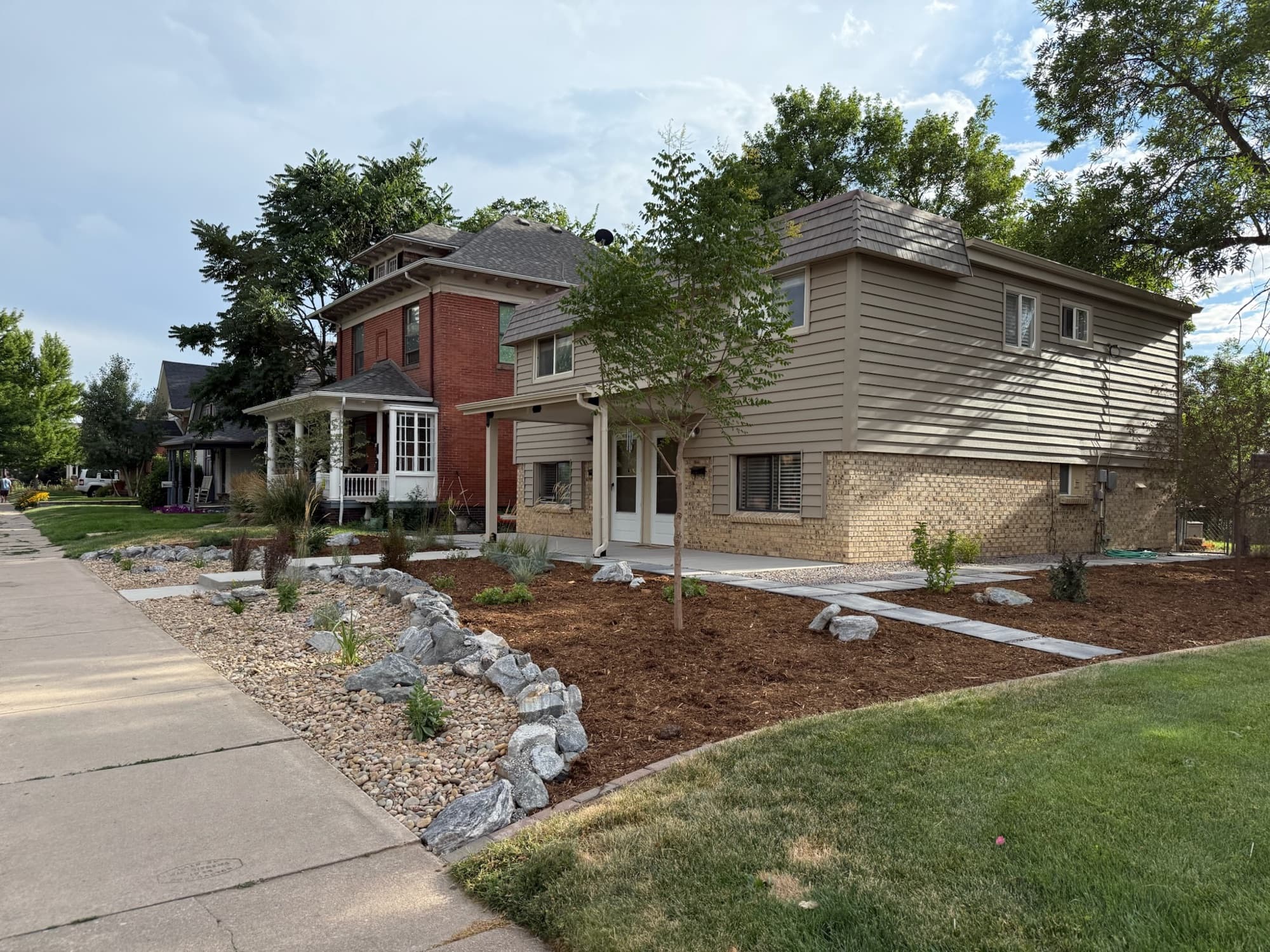
Removal only, or the whole conversion?
This page is the full job: grass out, soil and grade fixed, sprinklers converted, new landscape in. If you only want the grass gone — you're planting it yourself, or you want it out this fall and a plan in spring — sod removal has an instant price calculator and the same crew.
Why Denver homeowners are pulling out grass
Turf is where the water goes. Kentucky bluegrass needs roughly 25 to 30 inches of water per season in Denver, and the Front Range gets 14 to 15 inches of rain. Everything else — the sprinkler runtime, the bill, the restrictions — is compensation for that gap.
That gap stopped being theoretical in 2026. Denver Water declared its first Stage 1 drought since 2013, then voted to end the lawn watering season entirely on October 1 — a ban that carries into spring 2027 unless the board votes to lift it. Streamflow came in at 22% of normal, the lowest in 110 years of recordkeeping.
Removing the lawn isn't a sacrifice play anymore. It's the move that takes your yard out of the fight.
What lawn removal actually involves
Most of what goes wrong on a DIY removal happens below the surface.
Cutting the sod is the easy part. A rented sod cutter takes the green off in an afternoon. What it leaves behind is a compacted, thatch-bound layer that has spent years under irrigation and foot traffic — soil that drains badly and roots poorly. Drop natives into it untouched and you get a bed that looks fine in June and dies in August.
The root layer decides whether it comes back. Kentucky bluegrass rarely returns once the crown and root mat leave the property. Bermuda grass and quackgrass do, because their rhizomes run deeper than a sod cutter reaches. Identifying which one you have before the quote is the single most important thing we do on a removal job — get it wrong and you're redoing the bed in two seasons.
Your sprinklers are now a liability. Spray heads that were sized for turf will drown a xeric planting and, after October 1, running them on grass is a finable offense with Denver Water. Converting those zones to drip isn't an upsell — it's what makes the new landscape legal to water and keeps the plants alive through establishment.
Grade and drainage get decided now. The moment the turf is off is the only cheap opportunity to fix a slope that has been dumping water against your foundation for a decade. Once the rock and plants go in, changing it costs real money.
Want a number before anyone comes out? Our sod removal cost calculator prices the tear-out by square footage in about thirty seconds.
Rebates: check before you dig
This is where people lose money.
Turf-replacement programs belong to water providers, and they change every year — dollar amounts, square-foot caps, application windows, and what the new landscape has to be (usually a minimum share of living plants, not bare gravel or artificial turf). Some are already gone for 2026: Denver Water's turfgrass removal discount, run through Resource Central with Resource Central's own crews, was fully allocated as of September 2026. Others, like Aurora Water's GRIP and Highlands Ranch Water's program, run on their own calendars.
What almost all of them share is approval before removal. You apply, and you wait for the yes, before the grass comes out. Homeowners who tear out the lawn over a motivated weekend and then go looking for the rebate usually find they've disqualified themselves.
You apply to the program yourself. What we do is tell you which programs apply to your address, design to their requirements, and hold the sod cutter until you have approval. Our city pages link each provider's current program.
What goes in after
The removal is a means, not an end. Where the grass was, you have real options:
- Native and xeric planting — perennials, ornamental grasses, and shrubs matched to your soil, sun, and slope. Lowest water, highest habitat value, and the best-looking outcome in year three. See xeriscape installation and plant & install.
- Artificial turf — when you need a surface that takes dogs and kids and stays green. Best used in defined zones, not as a wall-to-wall carpet.
- Hardscape and rock — patios, flagstone, decomposed granite paths, and outdoor living space that earns its footprint.
Most of our projects end up as a blend: a practical turf area where people actually play, hardscape where people actually sit, and planted xeriscape everywhere the grass was only ever there out of habit.
Common questions
- How much does lawn removal cost in Denver?
- Removal and haul-away alone is priced by square footage, access, and slope — the sod removal calculator at xerislandscaping.com/sod-removal-denver/ gives you an instant range. The replacement landscape is priced on top — our xeriscape work starts at $6 per square foot. We price the full conversion after walking the site.
- Can I get a rebate for removing my lawn?
- It depends on your water provider and the year. Denver Water's 2026 turfgrass removal discount, run through Resource Central with its own crews, was fully allocated and closed as of September 2026. Aurora Water and Highlands Ranch Water run their own programs with their own windows. Almost all of them require approval before you remove anything — tear the grass out first and you typically forfeit it. You apply to the program yourself; we'll tell you which ones apply to your address and design to their rules.
- What's the best way to kill a lawn — sod cutting, sheet mulching, or solarizing?
- Sod cutting is fastest and what we use on most jobs — the grass and its root layer leave the property the same day. Sheet mulching (cardboard and mulch) is cheaper and builds soil but takes a full season and can leave bermuda and quackgrass alive. Solarizing under plastic works in a hot open summer but is slow and ugly for months. If you want to plant this season, cut the sod.
- Will the grass grow back?
- Kentucky bluegrass rarely does once the root layer is removed. Bermuda and quackgrass are a different story — they run from rhizomes below the cut depth, and they need either a deeper removal or a follow-up treatment. We identify what you actually have before quoting, because getting that wrong is the number one cause of a redo.
- When is the best time to remove a lawn in Denver?
- Fall is the ideal window. Soil is still warm, the grass is going dormant anyway, and anything you plant sets roots before spring. Spring is the second-best. In 2026 there's an added reason: Denver Water ended lawn watering on October 1, so new sod can't be established, while drip for new beds stays allowed.
- Do I have to replace it with rock?
- No — and please don't default to it. A yard of bare gravel gets brutally hot, reflects heat into your house, and still grows weeds. Most of our removals become planted xeriscapes: native perennials and grasses with mulch and some stone as accent. Rock is a material, not a plan.
Read more
Lawn Removal in Denver: the full how-to
How to remove your lawn in Denver — cost per sq ft, 4 removal methods compared, DIY vs. pro, and what to plant in its place.
Denver xeriscape rebates: what's available now
Denver Water's 2026 xeriscape rebate program is closed — but other Front Range programs are still active.
Grass alternatives that actually work here
The best grass alternatives for Denver yards — buffalo grass, blue grama, creeping thyme, clover, and DG, with water use and maintenance compared.
Denver's October lawn watering ban
Denver Water ended lawn watering Oct. 1, 2026, and the ban runs into spring 2027. What's banned, what's still allowed, and why your trees are the real risk.
What a Denver yard makeover really costs
What landscaping costs in Denver: front yard and backyard makeover prices per square foot, what pushes the number up or down, and how long it takes.
Grass removal + turf installation, start to finish
How artificial turf is installed in Denver, step by step — lawn removal, base prep for clay soil, seaming, infill, and a day-by-day timeline.
Where we work
We’re Denver-based and work across the metro. Water rules and rebates depend on your provider — each city page covers yours.
Ready to get a number?
We design and build water-wise landscapes across the Denver metro. Free walkthrough, honest scope, no pressure.