

Artificial Grass for Dogs in Denver: What Actually Works (and What Doesn't)
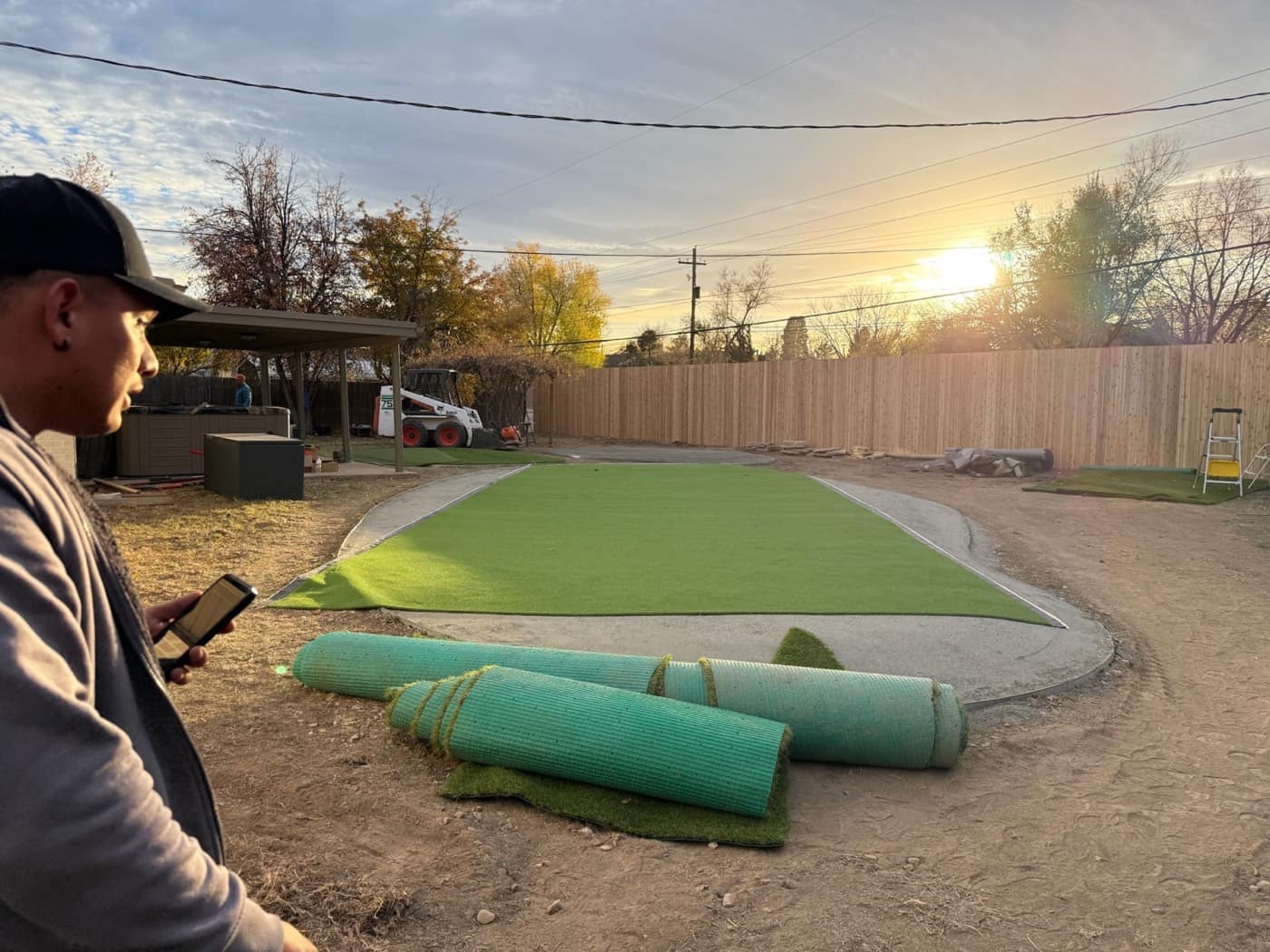
Dogs ruin grass. Not sometimes — always, eventually. Urine patches kill Kentucky bluegrass in weeks. Heavy-use paths turn to bare dirt by mid-summer. Muddy paws track through the house from March through June. And the planting beds you actually care about? Those get excavated, usually by July.
Artificial grass is the obvious answer. But "artificial grass" covers an enormous range — from properly engineered pet turf that drains fast and smells like nothing, to cheap product with marginal drainage that smells like a kennel by year two. The gap between those two installs is wide, and most of what you'll find online doesn't explain it clearly.
This is the honest breakdown: what actually separates a good pet turf install from a bad one, what the real concerns are (drainage, heat, PFAS), and how to think about design when your dog is the primary end user of your backyard.
65%
Of turf inquiries come from dog owners
15+ gph
Per sq ft minimum drainage rate for pet turf
2x
Longer lifespan with proper base vs. cheap install
Drainage Is the Only Thing That Matters
Every other variable — infill type, pile height, fiber softness, brand name — is secondary to drainage. Because when drainage fails, everything fails. Urine pools on the surface or sits in the infill layer. Bacteria multiply. The ammonia smell becomes permanent. No amount of hosing down or enzyme cleaner rescues a poorly drained pet turf install.
The number to know: 15+ gallons per square foot per hour. That's the drainage rate a pet turf system needs to handle heavy use without holding moisture. High-end perforated backing can hit 30–40+ gal/sq ft/hr. Standard outdoor turf with minimal perforations might drain at 3–5 gal/sq ft/hr — fine for a putting green, completely inadequate for a dog run.
Good drainage depends on two things working together: the turf backing itself and what's underneath it. Perforated turf backing with drainage holes every few inches is table stakes. Underneath that, you need a 4-inch crushed aggregate base (3/4-inch minus compacted) that allows liquid to move freely to grade and away from the surface. A drainage mat between the aggregate and the turf backing accelerates this further and is worth the added cost for any pet-specific install.
Bad drainage looks like: standard landscape fabric under the turf, thin base, no slope engineering. The liquid has nowhere to go, stays in contact with the infill layer, and that's the install that smells in year two.
Infill: What to Use and What to Avoid
Infill is the granular material installed between the turf fibers. It adds weight to hold the turf flat, supports the pile upright, and — in pet-specific applications — plays a direct role in drainage, odor control, and surface temperature. The wrong infill choice undermines an otherwise solid install.
Avoid
-
⚠
Crumb rubber infill — old, cheap, and a documented source of PFAS and heavy metal leaching. Gets extremely hot in summer. No antimicrobial properties. Avoid for any pet application.
-
⚠
Standard landscape fabric base — blocks drainage, traps moisture under the turf, creates the odor problem. Not a substitute for crushed aggregate.
-
⚠
No antimicrobial treatment — without it, bacteria from pet waste colonize the infill layer and the smell becomes structural, not just surface-level.
Choose
-
✓
Cork/coconut husk infill (Corkonut or equivalent) — natural, biodegradable, significantly cooler than silica or rubber, pH-neutral, and has natural antimicrobial properties from the coconut husk. Best option for pet turf.
-
✓
Antimicrobial-coated silica sand — neutral option that works well when paired with a proper drainage base. More affordable than cork/coco blends. Requires more active cleaning maintenance.
-
✓
PFAS-free verified infill — regardless of type, ask for third-party documentation confirming no detectable PFAS. Any reputable supplier should be able to provide this.
PFAS: Why It Matters More for Dogs Than You Might Think
PFAS — per- and polyfluoroalkyl substances, sometimes called "forever chemicals" — have received significant attention in the context of artificial turf, primarily through research on athletic fields. The concern is relevant to residential pet turf, but for a different reason than most people expect.
The concern isn't primarily dermal exposure for humans who occasionally walk across the surface. The concern is dogs specifically, for two reasons: they're on the surface constantly, and they lick their paws. A dog that spends hours per day on turf and grooms regularly has significantly higher exposure potential than a human who walks barefoot across the same surface occasionally.
The industry has moved substantially away from crumb rubber infill (the primary source of concern in earlier research), and most current-generation turf products are manufactured without PFAS in the fiber or backing. But "most" isn't a guarantee — some lower-cost products still use coatings or stabilizers that contain PFAS compounds, and not every supplier will volunteer that information unprompted.
The ask is simple: request written documentation — third-party lab testing, manufacturer certification, or SaferGrass/NSF certification — confirming the specific product and infill you're being quoted are PFAS-free. Reputable installers will have this. Anyone who can't provide it is a reason to keep looking.
Heat Performance in Denver Summer
Denver gets 300 days of sun per year. Artificial turf in direct summer sun can reach 130–150°F on the surface — hot enough to burn dog paws, which are significantly more sensitive to surface temperature than bare human feet.
This is a real constraint, and any honest installer should walk you through it rather than minimize it. The mitigation options:
Shade Structures
A pergola, shade sail, or mature tree canopy over part of the turf area drops surface temperature by 30–50°F. If you're designing a dog run from scratch, orient it to get morning sun (cooler) and afternoon shade. A properly placed shade structure makes the space usable during Denver's peak heat hours (noon to 4 PM) when unshaded turf would be off-limits for paws.
Infill Selection
Cork/coconut husk infill runs measurably cooler than silica sand, which runs cooler than crumb rubber. This is one of the non-cosmetic reasons cork blends justify the price premium for pet applications. It won't make 100°F-ambient turf comfortable at 2 PM in August, but it reduces the worst-case surface temps meaningfully.
The Simple Fix
A garden hose for 60 seconds drops turf surface temperature by 40°F almost instantly. Most dog owners learn this quickly and keep a hose handy during summer. It's not a design solution, but it works.
Cleaning: What Actually Works
The maintenance routine for pet turf is simple when drainage is right — and miserable when it isn't. Assuming you have proper drainage installed:
Daily: Pick up solid waste. Rinse the area with a garden hose. That's it.
Weekly: Diluted enzyme cleaner (products like Simple Green Outdoor Odor Eliminator or Nature's Miracle Outdoor Formula) applied with a hose-end sprayer, left to dwell 5–10 minutes, then rinsed. Enzyme cleaners break down the urea and proteins at the source — they're the only cleaning approach that actually eliminates odor rather than masking it.
Never use bleach. Bleach disinfects but doesn't eliminate odor-causing compounds — it masks them temporarily and then they return. More importantly, bleach degrades the turf fibers over time and kills any antimicrobial treatments in the infill.
A stiff brush or power broom every few months keeps the pile upright and the infill evenly distributed. That's the full maintenance program for a well-installed pet turf system.
Design Decisions: Dog Run vs. Full Yard
Before you think about product specs, decide which approach fits your yard and your dog's actual behavior.
Dedicated Dog Run
A designated turf zone — typically 10–15 feet wide, along a fence line or side yard — gives your dog a defined space with no-dig borders and easy cleanup. This works well when: you have a larger yard and want to preserve other zones for planting or native landscaping, your dog has a predictable patrol pattern you can design around, or you want to minimize the total turf footprint for cost or environmental reasons.
Design details that matter for a dog run: slope the base at a minimum 1% grade toward a drain or away from the house so liquids clear the surface and don't pool. Install bender board, steel edging, or concrete mow strips around the perimeter — dogs dig at edges, and physical edging buried 3–4 inches is the only reliable deterrent. Perimeter anchoring (nails or staples every 4–6 inches along the border) prevents the turf from lifting at the edges, which is where digging starts.
Full Yard Turf
For smaller yards — under 1,500 square feet — or homes where the dog effectively owns the entire backyard, a full yard install often makes more sense than a partial zone. The cost-per-square-foot math improves at scale, and you avoid the problem of the dog destroying the natural grass or plantings immediately adjacent to the turf zone.
Full yard installs still benefit from design structure: a paved or decomposed granite patio zone (turf gets hot), a shade structure for summer, and native or xeric plantings in raised beds with edging protection around their perimeter.
What a Proper Pet Turf Install Includes
If you're evaluating quotes, this is the checklist. Any install that's missing multiple items here is cutting corners that will cost you later.
-
✓
Drainage base — 4 inches of compacted 3/4-inch minus crushed aggregate. Not decomposed granite, not native soil with fabric. Crushed aggregate that liquid can move through freely. Sloped to grade at minimum 1%.
-
✓
Drainage mat — a permeable drainage layer between the aggregate base and the turf backing. Accelerates liquid movement, prevents compaction of the base from above. Highly recommended for any dog-specific install.
-
✓
Pet-specific turf product — perforated backing with a drainage rate of 15+ gal/sq ft/hr. Not standard landscape or sports turf repurposed for a dog run. Ask for the drainage spec sheet.
-
✓
PFAS-free documentation — written third-party confirmation that the specific turf product and infill being installed contains no detectable PFAS. Not a verbal assurance — a document.
-
✓
Antimicrobial infill — cork/coconut husk blend or antimicrobial-coated silica. No crumb rubber. Infill weight and type specified in the quote, not left vague.
-
✓
Perimeter anchoring — nails or staples on 4–6 inch centers along all edges, plus physical edging (steel, bender board, or concrete) buried 3–4 inches to prevent digging.
-
✓
Seams — if the install requires seams, they should be glued (not just stapled), run perpendicular to primary viewing angles, and be invisible at standing height.
-
✓
Warranty — a reputable install carries an 8–15 year product warranty from the manufacturer and a separate workmanship warranty from the installer. Get both in writing.
Get an Artificial Grass Estimate for Your Denver Yard
We install pet turf across Denver and the Front Range — proper base, PFAS-free verified products, drainage that performs. Tell us about your yard and your dog and we'll put together an honest estimate.
Xeris does this work. See our Artificial Turf Installation service in Denver — what's included, what it costs, and how to get a free walkthrough of your property.