

Commercial Landscaping in Denver: Low-Water Solutions for Properties and HOAs
Commercial landscaping in Denver carries a cost most property managers accept without questioning: high water bills, frequent maintenance visits, and turf that struggles through Colorado's hot summers and unpredictable springs. For office parks, HOAs, multi-family properties, and retail centers, that adds up fast.
More commercial properties across the Denver metro are switching to xeriscape for lower operating costs, lighter maintenance, and better year-round appearance — and since January 2026, Colorado law has taken new decorative turf off the table for most of these sites anyway. Our commercial and HOA landscaping service handles those conversions from site walk to install.
The Real Cost of Traditional Commercial Landscaping in Denver
Traditional commercial landscaping — sod, spray irrigation, regular maintenance crews — was designed for climates with consistent rainfall. Denver averages 14 inches of rain per year. The result is that most commercial turf on the Front Range is on life support from May through September.
The carrying costs on a property with large turf panels typically include:
- Water: the biggest seasonal line item on most irrigated sites, and the one most exposed to drought rules and rate increases
- Maintenance: weekly mowing through the season, plus fertilizing, aerating, and pest control
- Repairs: Irrigation head replacements, turf patches, seasonal overseeding — unpredictable but constant
- Drought stress: Browning turf hurts the property's appearance and draws HOA or tenant complaints — and under Denver Water's 2026 Stage 1 drought rules, watering grass is prohibited from October 1 (Denver Water)
Those costs repeat every year with no end point. Xeriscape changes the model: higher upfront investment, dramatically lower recurring costs, and a landscape that actually improves as plants establish rather than degrading under stress.
SB24-005: New Turf Is Off the Table on Commercial Property
Colorado's SB24-005 changed the math for commercial sites. Starting January 1, 2026, local governments can't allow the installation of nonfunctional turf, artificial turf, or invasive plants on commercial, institutional, or industrial property, on HOA common property, or in street rights-of-way, parking lots, medians, and transportation corridors (SB24-005). Nonfunctional turf is grass that isn't used for recreation — the decorative strip along the entry drive, the panel in front of the office building, the parking-lot island. Athletic fields are exempt. A 2025 follow-up, HB25-1113, extends the rules to multifamily properties with more than 12 units starting in 2028 (HB25-1113).
What that means in practice:
- When decorative turf fails or gets torn out, it can't go back in — not as new sod, and not as artificial turf.
- The replacement is xeriscape: native and drought-adapted plants, mulch or rock, and drip irrigation.
- Turf that people actually use — a courtyard lawn, a dog area, a play space — is a separate question. Keep it where it earns its keep, and convert everything else.
We don't install new decorative turf or artificial turf on commercial grounds, entries, parking islands, or HOA common areas. We convert them to xeriscape.
What Commercial Xeriscape Actually Looks Like
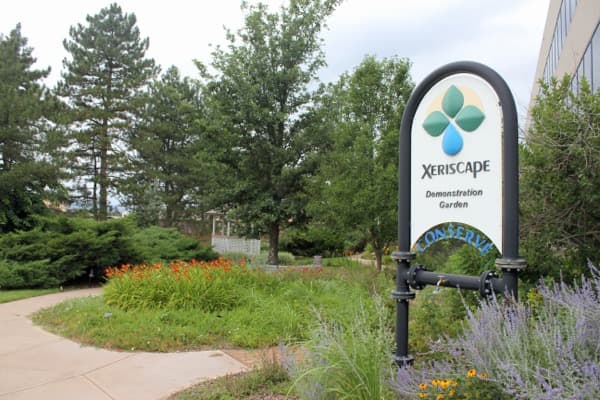
Commercial xeriscape isn't gravel and cactus. Done well, it's a structured, professional landscape that reads as intentional and well-maintained — often more polished than stressed bluegrass.
Common elements in Denver commercial xeriscape installations:
Mass Plantings of Native and Drought-Tolerant Shrubs
Ornamental grasses, rabbitbrush, four-wing saltbush, and native shrub masses create visual structure with minimal water requirements after establishment. They look deliberate and designed rather than sparse.
Decomposed Granite and Mulch Groundcover
Inorganic groundcover (decomposed granite, crushed rock) and organic mulch reduce irrigation needs, suppress weeds, and give the landscape a finished appearance year-round — including through Denver's winters when turf turns straw-colored.
Defined Hardscape Zones
Walkways, seating areas, and defined edges separate functional zones and reduce the total planted area that needs maintenance. Boulder placement and flagstone add visual interest without ongoing care requirements.
Drip Irrigation With Smart Controls
Commercial xeriscape installations use drip systems with zone-specific programming and weather-responsive controllers. Irrigation is targeted and measurable — property managers can track usage and document conservation for reporting purposes.
Seasonal Color With Perennials
Native perennials — penstemons, blanket flower, black-eyed Susan, salvia — provide seasonal color without the replanting costs of annual flower programs. They return each year, spread over time, and require no supplemental irrigation once established.
Commercial Properties That Benefit Most
Not every commercial property has the same profile, but these are the ones with the most to gain:
HOAs and Planned Communities
Landscaping is one of the biggest controllable line items in most HOA budgets. Converting common area turf to xeriscape cuts both water use and maintenance frequency — from weekly mowing to a handful of seasonal visits. It also removes the eyesore of drought-stressed turf during watering restrictions, and SB24-005 already bars new decorative turf on common property.
Multi-Family Properties
Apartment complexes and condominiums with large landscaped areas — entry corridors, courtyard perimeters, parking lot islands — have a lot of low-use turf to convert. Parking lots are already covered by SB24-005, and larger multifamily properties come under the turf rules in 2028.
Office Parks and Corporate Campuses
Large turf areas around office buildings are primarily visual — rarely used recreationally. That's the definition of nonfunctional turf. Converting it to xeriscape drops a high-cost, low-utility maintenance item while improving curb appeal and supporting tenants' sustainability reporting.
Retail and Mixed-Use Centers
Entry landscaping, parking islands, and storefront plantings benefit from the year-round visual consistency of xeriscape. Unlike turf, drought-adapted plants look the same in August as they do in May.
Municipal and Institutional Properties
Schools, government buildings, and institutional facilities under budget pressure find xeriscape a defensible long-term investment — lower annual costs, and institutional property is squarely covered by SB24-005. For the bigger picture on public landscapes, see our piece on why Denver's roadsides and medians are a missed xeriscape opportunity.
Rebates and Conservation Programs
Commercial and HOA incentive programs change year to year and differ by water provider — Denver Water, Aurora Water, South Suburban, Centennial Water, and others each run their own. Check your provider's current commercial programs before you finalize a budget; Denver Water's are listed on its rebates page. Some programs require approval before work starts, so ask early. We'll tell you which programs apply to your property.
Maintenance Advantages for Property Managers
For property managers, the maintenance model shift is often as valuable as the water savings. Traditional commercial turf requires consistent weekly attention — any gap in service is visible immediately. Xeriscape maintenance is fundamentally different:
- Seasonal visits, not weekly crews: Established xeriscape runs on a handful of seasonal visits — spring startup, midsummer check, fall cleanup, and irrigation winterization — instead of a mowing crew every week of the season.
- No mowing: Eliminating turf eliminates the noise, fuel, and labor of weekly mowing — a significant operational simplification for properties with multiple buildings or distributed common areas.
- Predictable costs: Xeriscape maintenance costs are more predictable year over year than turf maintenance, which is subject to drought surcharges, pest pressure, and emergency irrigation repairs.
- Lower vendor dependency: Fewer required visits mean less vendor coordination and fewer service windows to manage.
How Commercial Xeriscape Pricing Works in Denver
Commercial pricing depends on site conditions, existing irrigation, plant selection, hardscape scope, and access (traffic control, working hours, and staging all matter on commercial sites). Our published starting rates are the same ones we use for residential work:
- Planted xeriscape (rock, plants, shrubs, trees): from $6/sq ft, most projects $6–10/sq ft
- Budget options (wildflower planting, arborist mulch): from $4/sq ft
- Concrete and hardscape (paths, pads, walls): from $8/sq ft
- Design: $500, credited toward the project on installs over $5,000
Payback depends on how much turf you're replacing, what your water provider charges, and what you're paying for maintenance now — so we'd rather run your numbers than quote a generic break-even. See our xeriscaping cost guide for how pricing breaks down, then request an estimate for a commercial site assessment.
Frequently Asked Questions About Commercial Landscaping in Denver
Can we convert just part of the property to xeriscape?
Yes, and phased conversions are common for commercial properties. Many clients start with the highest-visibility or highest-water-use areas — entry corridors, large turf panels along streets — and convert additional areas in subsequent years. Phased conversion spreads capital cost while delivering early savings.
Will xeriscape meet HOA appearance standards?
In most cases, yes. The key is working within the HOA's architectural standards before the design is final. Well-designed xeriscape looks maintained year-round rather than struggling through summer. And for common areas, SB24-005 means new decorative turf — real or artificial — isn't an option anyway. More in our HOA landscaping guide.
How do we handle the transition period while plants establish?
New xeriscape plantings require more irrigation in their first season while roots establish. This transition period typically runs 6–18 months depending on plant types and installation timing. We provide an establishment watering plan and can build establishment-period maintenance into the scope.
Do commercial xeriscape installations qualify for LEED or sustainability certifications?
Water-efficient landscaping can contribute to LEED credits, particularly outdoor water use reduction. We can provide the plant list and irrigation design documentation your certification consultant needs.
What happens to existing irrigation infrastructure?
Existing irrigation infrastructure is typically converted rather than replaced entirely. Spray heads are replaced with drip emitters and distribution tubing, and controller programming is updated. In most cases, the main lines and valve infrastructure can be retained, reducing the cost of the irrigation component significantly.
Ready to Talk About Your Commercial Property?
Xeris installs low-water, low-maintenance landscapes for commercial properties and HOAs across Denver and the surrounding metro. Request an estimate — we'll walk the site and give you a real number.